

OH YoU BeAUTiFuL BaBY
f. ) E mil y
o
Jacob
a,
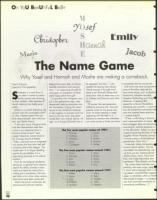
The Name Game
Why Yosef and Hannah and Moshe are making a comeback.
Gloria Charnes
Special to The AppleTree
hoshana is in and Stacy is
out when it comes to names
. . • •
Jewish parents are choosing
for their children. After decades of
denial, ethnicity has finally gone
I public.
What's in a name? Everything sig-
nificant, from the sociologist's point
I of view. Names reveal what you
I think about yourself, your value sys-
tem, your family history.
"In the past, many immigrant Jews
I and their descendants shed their
culture in an obsessive drive to
become Americanized," says
Joseph Tabachnik, former head of
the Chicago Board of Rabbis.
"Today, most Jews are so integrated
1 into society that they don't feel self-
: conscious about their religion. The
modern Jew is no longer rebelling
against his grandfather. He is
responding positively to his cultural
tradition."
From the sociological standpoint,
Americans in general have come to
I cherish the ethnic diversity in their
midst and reject the notion that a
melting pot is mandatory. The soci-
etal fabric is far richer when various
distinctions have been preserved.
Within the Jewish community, the
1 trend toward continuity reaches
5/15
1998
78
deeper than mere style. It conveys
heartfelt convictions and associa-
tions — an outpouring of pride for
one's past, an expression of formi-
dable hope rather than guilt.
Contrast this with immigrants who,
just a few generations ago, were
desperately seeking absorption into
the mainstream, longing for instant
access to the Goldenah Medinah.
In their urgency to succeed and find
favor in the new land, they aban-
doned their own cultural identity. All
right, so in Europe Shloimeh was to
ert
1
2. James
Jahn
4 William
5. Richard
1 be expected. But here — who
needed the teasing and ridicule
1 Would anyone in his right mind
name a son Shmuel? Sidney had
more class. And so there was a run
1 on Sidneys and Sherwins and Shel-
1 dons.
Of course, the next generation
I outdid the previous one: The most
I popular name for this group was
Scott, for those needing a name
1 beginning with the letter S. It
became so common that whenever
you came across a Scotty you knew
immediately that he was Jewish.
And Scott was tame compared to
1 some of the other treasures that
I have come along, such as Bradforo
1 Markowitz, Lafayette Levinthal,
1 Celestine Goldschlag and Forsyth<
Fleishman. A leading IBM
I researcher is Benoit Mandelbrot.
I Interesting, but certainly — evolving
I from the somewhat convoluted ratio
nale that inspired these selections
— entirely logical.
Of late, a rekindling of ethnicity
and a re-examination of values
1 have emerged. Jews are becoming
1 more Jewish, and the emphasis is
on the affirmative. Today, we see a
couple announcing the birth of their
1 daughter Miriam Hannah, named
1 in loving memory of her maternal
grandmother, Mary Ann.
Fortunately, today the tendency
1 toward cultural realism. We are
intimidated into abandoning who
1 we think we are. Naming Jewish
1 children Brian, Kevin, Tracy and
1 Kelly won't help them move into
mainstream. They already are there
The current trend indicates com-
patibility with one's origin, keepil
1 in touch With a heritage held in lov-
ing esteem. Grandchildren appear
eager to remember what our forefa
,
tners fought to forget — a progres-
; sion from awkward uncertainty to
unwavering confidence. ❑