
eINEntertairunent
Mixed Media,
News er Reviews.
A YIDDISH' MANDY
One Jewish celebrity missing from
last month's star-studded Hollywood
tribute to Israel's 50th birthday was
Mandy Patinkin.
The quintessentially Jewish per-
former has a strong point of view
when it comes to his Jewish life. In
this case, it was politics that kept him
away.
He declined an invitation to partic-
ipate in the tribute, which was co-
hosted by Kevin Costner and Michael
Douglas, because he is deeply opposed
to the current Israeli government's
attitudes toward the Middle East
peace process.
"I would love to participate but I
feel like my hands are tied," he said of
the show that aired April 15 on the
CBS television network.
Sitting in his snug home office
recently in the rambling Manhattan
apartment he shares with his wife and
two adolescent sons, Patinkin said of
the stalled peace process: "It's a
tragedy, what's happening. I pray with
every ounce of my being that the
peace process continues.
"It's a symbol for the entire world,
and if it's not attended to, we'll all
have a heavy price to pay."
Patinkin's work is infused with the
Jewish sensibility that characterizes his
life.
His convoluted syntax and urban
inflection when he spoke as Dr. Jeffrey
Geiger on the television program
"Chicago Hope" suggested that the
character's birthplace was a shtetl.
Then there was the movie Yentl, in
which he played the yeshiva study
partner of the "boy" played by Barbra
Streisand. Now the Tony- and Emmy
Award-winning performer has come
out with a Yiddish compact disc, on
which he mixes classic Yiddish musical
gems with unexpected American songs
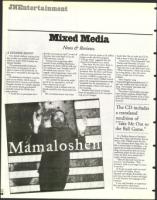
translated into the mamaloshen, or
mother tongue, which is the name of
the recording.
Patinkin heard shards of Yiddish
from his grandparents as he was grow-
ing up on Chicago's
South Side. But to make the CD he
had to learn it from the ground up.
Classics like "Oyfn Pripetshik" and
"Raisins and Almonds" are inter-
spersed with translated renditions of
"Take Me Out to the Ball Game" and
"White Christmas," which was written
by Irving Berlin, a Jew who never
wrote a single lyric in his native
Yiddish.
Mary Poppins' song
"Supercalifragilisticexpialidociou s" is
part of a medley that starts with the
song "Ten Kopeks" and ends with
"The Hokey Pokey."
The project started eight years ago,
when theater producer Joseph Papp
asked his friend Patinkin to do a bene-
fit for the YIVO Institute for Jewish
Research.
The CD includes
a translated
rendition of
"Take Me Out to
the Ball Game."
At a Shabbat dinner at Patinkin's
home later, Papp told Patinkin that he
had to make Yiddish music his own.
The comment from Papp, who was
like a second father to Patinkin — he
signed the ketubah at Patinkin's wed-
ding, and carried his first son at the
traditional pidyon ha-ben ceremony
when the baby was a month old —
made a lasting impression.
"Then Joe dies and won't let me
out of it," said Patinkin. "This
promise I made to Joe began to loom
in my face."
So he got in touch with two mod-
ern masters of Yiddish, Henry
Sapoznik and Moishe Rosenfeld, who
gave him a box full of tapes and began
to teach Patinkin the language of his
ancestors.
It was, said Patinkin, an experience
that captured his whole heart.
"His inflection, his pronunciation is
Scanned image of the page. Keyboard directions: use + to zoom in, - to zoom out, arrow keys to pan inside the viewer.
May 15, 1998 - Image 114
- Resource type:
- Text
- Publication:
- The Detroit Jewish News, 1998-05-15
Disclaimer: Computer generated plain text may have errors. Read more about this.