

time, she needed radiation, too, which
meant that she would lose her hair.
Again, my mother continued to work
while receiving treatment. She was
determined to live a "normal" life,
despite the cancer. We eventually went
to buy a wig because a turban was not
appropriate school attire. It was hard for
me to accompany her for treatments; I
just couldn't imagine being in her place.
At the cancer center, every patient was
set up in a back room, with needles and
tubing stuck in their skin. The treat-
ments seemed routine to them.
What gave me hope was my mother,
and her continuous effort to get better.
She is such a strong and brave person.
No one really knows what it's like to be
"living with cancer," until they are
faced with it. There are ups and downs.
I admire my mother for all the dreaded
doctor visits, especially after she lost
hope in the doctors. I love her for all
the days that she went to work to make
sure that we had food on the table.
I have a certain respect now for
those afflicted with cancer. Everything
looks OK on the outside, but they lead
a life of tests and waiting for results.
In January, my mother was diagnosed
once again — with brain cancer. She
had regular doctor appointments, and
we had been living life as normal, until
she felt something was terribly wrong.
She was losing weight, feeling dizzy,
becoming forgetful and experiencing
hearing loss. Her oncologist said it was
nothing, that she was "cancer-free."
My mother knew better and insisted
on having a brain scan. Three weeks
later, I called 911 because she was
choking on food. In the hospital, the
on-call doctor looked at the results
from the brain scan and saw an irregu-
larity. We visited her doctor the next
day, and he started her on radiation a
week later.
She was more angry than shocked.
Once again, her claims had been
ignored. Even I had written a letter to
her doctor expressing my concern
about her weight loss. The 911 inci-
dent was fate — somebody finally
helped us learn what was wrong.
My mother has learned how impor-
tant it is to speak up when you feel
something is wrong with your body. As
sick as she is today, she still insists,
"You are your own doctor." My moth-
er emphasizes the importance of listen-
ing to instincts — yet another of the
valuable lessons she has taught me.
I love my mother very much, and I
pray each day that she will get better.
More than ever, she is the wind
beneath my wings.
❑
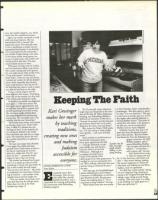
Keeping The Faith
Kari Grosinger
makes her mark
by teaching
traditions,
creating new ones
and making
Judaism
accessible for
everyone.
LYNNE MEREDITH COHN
Scene Editor
E
verybody knows Kari
Grosinger. She's the one
who looks like a Jewish
Isabella Rossellini, and is
responsible for creating and heading
the community-wide Rekindling
Shabbat program.
to the Orthodox, Kari's undoubtedly a
The 25-year-old, whose infectious
peacekeeper. But she's quick to point
laugh rings out frequently in the corri-
out that "I'm not observant." She goes
dors of the Max M. Fisher Federation
to shul once a month, goes out on Fri-
building, says Rekindling Shabbat is
day nights, after making Kiddush or
definitely an extension of who she is,
"because it's outreach and showing peo- having Shabbat dinner. The point of
saying this, she insists, is for people to
ple Judaism doesn't have to be some-
see that you can be excited about
thing you do twice a year and dread."
Shabbat and not super religious.
But, insists the Project STaR gradu-
A Detroit Country Day and U-M
ate, "I'm not trying to make people
grad, Kari loves the personal contact
more Jewish — just more Jewishly
”
part of her job best. She's the Federa-
aware.
tion liaison for Teva, the Federation syn-
Kari's interest in and devotion to
agogue committee, the YAD
the Jewish community stems
Shabbat program, and of
from great experiences she had
ct day for
A
pe7fe
course Rekindling Shabbat.
— through Tamarack, on the
Kari Grosinger
"You can gain someone for a
teen Alaska trip, and the fact
might i nclude
lifetime — or lose them —
that her father survived the
baking, or just
with a phone call," she says.
Holocaust. Although as a
doing n othing.
Kari doesn't know exact-
youngster she didn't know
ly
what
her dream job will
many of the details of her
be.
In
the
meantime,
she'll plan and
dad's escape from Nazi persecution, "it
play
—
that
means
baking,
reading
instilled in me how special the Jews
the
myriad
magazines
to
which
she
are. We're making a party for him next
subscribes
and
walking
around
Birm-
month, being in America 50 years,"
ingham, near her apartment.
she says.
An ideal day would include "taking
Two years ago, the Southfield-based
out my imaginary dog, sleeping in,
family trekked back to Karl's father's
eating at the Original Pancake House,
hometown of Mihalyfalva, on the Hun-
taking a nap, sitting around doing
gary-Romania border. She gets emo-
nothing. I like every once in a while
tional when talking about it. "It's so
to do nothing. I'm really good at it,"
important to keep tradition," she says.
Kari says, grinning. Ell
With friends from the very secular
5/8
1998