

he Scene
There's Always Hope
A 26-year-old daughter
pays tribute to her mother,
who's battling cancer.
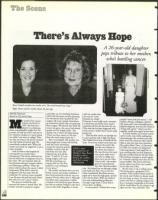
Renee Simlak considers her mother to be "the wind beneath my wings."
Right: Renee and her mother about 20 years ago.
RENEE SIMLAK
Special to The Jewish News
y mother's first cancer
(colon) was found in
1993. She had com-
plained to a physician
about unexplainable weight loss. For
months, he told her that it was due to
her obsessive tendency to worry about
me while I was away at college. Then
one day, by chance, the doctor noticed
that she looked extremely pale. He
immediately ordered tests. When the
results came back, he urged her to see a
colon specialist.
I was all alone at the hospital the
morning that my mother had a
colonoscopy. That doctor informed me
that he had found a malignant tumor in
her colon. We were shocked. After all,
her physician had gone months without
ever detecting a problem. When the
doctor told me about the cancer, I didn't
understand. What did he mean by
malignant? Did that mean that she
would die? Or was her tumor operable?
I was 20 years old and had never identi-
fied with the word "cancer" before.
The doctors worked fast and
removed the tumor a month later. My
mother wanted to postpone surgery
1ff
5/8
1998
126
until after my 21st birthday luncheon,
told my mother that
which she had spent months planning,
she was the "wind
but the doctors and I pushed for the
beneath my wings."
surgery. My mom started chemothera-
However, I never really took a moment
py treatments shortly after recuperating
to thank her and tell her how much I
from surgery. We learned that while the appreciate all that she has done for me.
tumor was gone, the cancer had already Now that she has been diagnosed with
spread into her lymph nodes. My
brain cancer, I realize that I haven't really
mother was a wreck. She kept saying,
grown up.
"Once you have cancer, it's all over.
With the first cancer, we decided not
Even the word cancer scares me."
to give up hope and to fight the illness.
But I was hopeful. My mother was
But I didn't know how to handle -all the
discouraged and uneasy, still dealing
pain. I loved my mother more than any-
with the initial resentment
thing in the world. She
toward her internist and his
was
the one I leaned on
Editor's ote:
inability to detect this dis-
for
advice
and wisdom.
In 'wog,/ ition of
ease from the start. She
She
was
the
one who took
Mother's Day, Renee
repeated the story all the
care
of
me,
made
sure I
Si,nlak's t ribute
time, "I told Dr. X I was
was
OK
at
college
and
honors he r mother
losing weight, and I just
drove
up
to
see
me
when
and their strong
felt like something was
I
had
a
cold.
My
mother
relationsh ip.
wrong with me, but they
gave me unconditional
told me it was nothing to
love that I found nowhere
worry about."
else. She helped put me through college
My mother has always been my best
and made sure that I was on my feet
friend, mentor and closest confidante. I
when I graduated. She always encour-
have lived exclusively with her since my
aged me to shoot for high goals, and she
parents' divorce when I was 5. Although
never let me down. With my mother's
my father and I stayed close, it didn't
love and understanding guiding me
compare to the bond that grew between
through rough times, I never had to
me and my mother. Perhaps it was that I worry about anything.
was an only child. Regardless, I always
As time passed, I realized how many
people I knew that had cancer — old
teachers, friends, colleagues, relatives.
_
My mom and I were eventually given a
hopeful diagnosis, but that she would be
"living with cancer." I knew our lives
together would never again be the same.
A school teacher, my mother contin-
ued to work, even while undergoing
chemotherapy. She worked every day,
then went for treatments after school.
After a year, she went into remission.
Her spirits lifted. Then, in December
of 1996, my mother was diagnosed
with lung cancer. I had urged her to
quit smoking after her first diagnosis,
but she couldn't kick the 50-year habit.
We had been through so much togeth-
er; I wanted nothing more than for her
to get healthy. The person that had
always taken care of me now needed
me to take care of her.
By this time, I was a college senior.
The doctor gave a prognosis of 18
months. That number always stayed in
her mind, and I believe it almost made
her lose hope at times. To receive treat-
ments, she had to undergo surgery and
have a metaport implanted in her body,
which would allow for the chemo to go
right into her vein, poke-free. This