
•
says Israeli-born artist
Efrat Baler of New York.
"People like Marc
Chagall and Ben Shahn
were Jewish artists who
\;- used Jewish themes but
painted in the style
wherever they lived at
the time.
"Because Israel has
many influences from
the United States and
Europe, today many
Israeli artists use many
conventions of the avant-garde," she
says.
"But most, though influenced by
current trends, can't completely get
away from the hills of Jerusalem.
"There may be no such thing as
`Israeli' art," she adds. "Every [immi-
grant] artist brought something into
the country and then taught it to new
generations. We don't yet have the his-
torical perspective to say if there is an
Israeli art."
Yet the Israeli art world is amazing-
ly rich and intense — more than 15
art schools, thousands of artists, ideo-
logical controversy and intercity cul-
tural wars. Regardless of the absence of
an avant-garde art market, it is a high-
ly diverse world.
Still, just like 40 years ago, there is
no alliance between society and art.
Israeli art speaks to itself. The dramas
of everyday existence in Israel over-
shadow the country's ability to make
space for art.
And so as it approaches the end of
the century, Israeli art is marked not
so much by Israel in art, but by art in
Israel. El
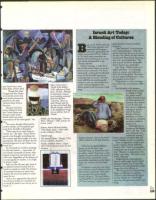
Above: Marcel Janco:
"Death of the Soldier;"
1949, collection of Dadi
Janco, Tel Aviv. Although
he derived the composi-
tion (tumbling wounded
bird and all) from
"Guernica," Janco set
aside Picasso grays for
the blue of the Israeli _kg
(bluish triangles outlined
in the background merge
into an abstract Star of
David).
artistic
y, Tel Avi
a.rdens of
ow streets
harnps Elys
,areali
Nahum Gu
the Bezald school, began to exu
yrichm and tenderness. His brush
Spoke gaily, washing the Israeli 1
scape in the beautiful aquas and
kiturquoise blues of nature. His inti-
mate still lifesportrayed peaceful
-women at rest on iron-scrolled bal-
conies with pomegranate trees,
flower gardens and the sea as a back-
are n
just ha P p-
e, leg p hts to a ew cohteth
r
acy artists who
ence.
are
i t making a di fF
L ea Ai
s e prep re
i e
v z,e dk
e th
female artist in
according to
She paints rn
studies of women,
are both intense an
intimate. Her dynam-
ic use of color and
l ine conv a bol
Middle: Jan Rauchwerger, "Interior
With a Woman," 1985, private col-
lection, Israel.
Bottom: Reuven Berman-Kadim:
Model Aleph," 1985-1988,
private collection, Rehovot.
Opposite page:
Top: Bezalel S : chatz: " Family," 1952,
private collection, Jerusalem. -
Middle: Avraham Naton: "Clown,"
1952-1953, collection of the Tel Aviv
Museum.
•
,•
abstract r
nent, hoNvever:.210#
were mostly , gra
trend and the „
ish expressionism-
.
Frenc h' i nfluence. The - years follow-
ing \World War II saw the formation'
5/1
1998
129
Scanned image of the page. Keyboard directions: use + to zoom in, - to zoom out, arrow keys to pan inside the viewer.
May 01, 1998 - Image 129
- Resource type:
- Text
- Publication:
- The Detroit Jewish News, 1998-05-01
Disclaimer: Computer generated plain text may have errors. Read more about this.