
MEntertainment
LINDA BACHRACK
Special to The Jewish News
T
State
There are no
easy definitions
of Israeli art.
t was simply a marriage of sit-
says Lila Silverman.
'
an her husband, Gilbert,
avid contemporary art
ectors, were in the midst of rnov-
" incomparable Fluxus art
allation to a newly renovated
ce at the Parker Webb Building in
etroit.
"One night, during the move, we
tertained James Snyder in our
ome and an idea was born," says
Silverman. Snyder is the director o
the Israel Museum in
: os
"Gilbert agreed that eveniiiitO
a fund-raiser for the museum that
would be tied to aViewing of our -
Fluxus collection in its new home."
The Silvermans and the Arnerican
Friends of the Israel Muse
Detroit Corninittee will host a cock:
tail and supper reception on
ednesday, May 13, at the Parker
Webb Building. It will provide an
exclusive opportunity to view the
Silverman Fluxus collection, the
world's largest collection of this
avant-garde, Dada-like art form*
Fluxus artists include Yoko Ono and
Oaes Oldenburg.
,
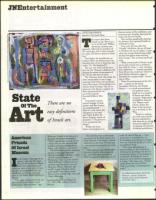
Israel Hershberg: . "Cow'si N
74, "19874988, collectionOf e l ssra:l.
Aluseum.
he rumor flew from
mouth to ear: 'Ben Guri-
on is on his way!' Within
moments, security men
appeared, followed by members of
the entourage, and in their immedi-
ate wake, the famous shock of white
hair."
Thus begins the introduction to
Gideon ()fiat's art history tome One
Hundred Years of Art in Israel (see this
week's "On The Bookshelf").
The year was 1958 and the occa-
sion was the "Decade" exhibition, dis-
playing the artistic achievements of
the 10-year-old State of Israel:
The infamous work that made the
show memorable? It was a huge
painting titled Power, by modernist
and prime mover of the abstract rev-
olution Yosef Zaritsky. The oil on
plywood with abstract angular SUS-
faces represented the vis-
tas of the recently
founded Kibbutz Yehi-
am.
It conveyed a monu-
mental message of mod-
ernism, and Ben Gurion,
.
an unsophisticated
observer, took notice. He
whispered to his loyal
aide Teddy Kollek, the
future longtime mayor of
Jerusalem, "The picture is
to be transferred else-
where!"
Within the hour,
Power was hanging in an
escri•ei ey some
as
e
the,nations encyclop edic
um
"The museum is an unbelievable-
feat and is loaded with wond er
art," says Silverman. Foun
1965, it maintains collections
in v r-
,
obscure section of the exhibition, and
sometime later Zaritsky destroyed the
work with his own hands.
This incident graphically expresses
the distance that separated Israeli art
and Israeli society.
Now, even 40 years after the
"Decade" exhibition, the art of Israel
is still about the art of a place, "a place „y
where the strong Mediterranean light ' \
dazzled immigrant artists arriving
from Europe." But its focus has broad-
ened.
What commenced as Zionist utopi-
an art and evolved into a confronta-
tion with the times — wars, immigra-
tion, settlement — became separated
from life and has ended up "locked in
post-Zionist alienation, eager to
<
demolish the utopian myth," accord-
ing to Ofrat.
From the enchantment of the Ori-
ent — camels on the beach,
Jerusalem's Old City, the Temple
Mount — to critical environmental
and political action,
Israeli art is a narrative
of dream and disillu-
sionment. Regionalism
and folklore matured
into Western mod-
ernism. Today, the
heart of the country's
art is set firmly in the
West.
"Israel is a melting
pot with many hetero-
geneous populations
and there are no strong
historical traditions of
art because of centuries
of biblical prohibition,"
ro
ne
a reas`
antiquities to contemporary art;
from Judaica to international design;
om the Dead Sea Scrolls to a thriv-
ing childrens wing.
"This year, the museum is
concentrating on the acquisition
of European paintings and they're
exhibiting Indian art including an
installation detailing the recon-
struction of an ancient synagogue
in India," Silverman says. 'Funds
x raised
ork.,, from OUT event will be
te
used to purchase a conmporary
For information about the Israel
Museum, contact American
Friends of the Israel Museum,
(212) 997-5611.
Scanned image of the page. Keyboard directions: use + to zoom in, - to zoom out, arrow keys to pan inside the viewer.
May 01, 1998 - Image 128
- Resource type:
- Text
- Publication:
- The Detroit Jewish News, 1998-05-01
Disclaimer: Computer generated plain text may have errors. Read more about this.