

that, I started handing in my work in
person."
Luckily, Hirschfeld never joined the
union. "If I had, I wouldn't be work-
ing today," he laughs. "I would have
had mandatory retirement at 65 or
70."
Over a span of 70 years at the New
York Times, Hirschfeld has seen count-
less plays and has captured the like-
nesses of nearly every acclaimed the-
atrical personality. During rehearsals
and performances, he studies gestures
and makes the initial drawings on a
small notebook he keeps in his pocket.
He uses a HB Venus pencil, inks over
the initial sketch, then erases the pen-
cil.
His theatrical caricatures have led
the way to a new genre. In a recent
tribute to Hirschfeld in the New York
Times, David Leopold writes: "His is
a special and, yes, a unique style.
Instead of deflating his subject, a tra-
dition in caricature, he joins the actors
in their pantomime, capturing their
characters in so few lines."
Hirschfeld's subjects include taknts
in all areas of the performing arts. In
addition to thespians, he captures per-
sonalities from the worlds of opera,
television, film and music. Famous
faces from David Letterman to Itzhak
Perlman to Irving Berlin have been
portrayed by the strokes of
Hirschfeld's pen. In recreating an
event, the artist has squeezed up to 60
people into one drawing. It's not sur-
prisingly that he has been referred to
as a "national treasure."
Hirschfeld's early influences were
Charles Dana Gibson, who created the
Gibson Girl, and John Held Jr., illus-
trator of the Jazz Age. But, he says, it
was a trip he took to the Far East in
1932 that had the greatest influence
on his style.
"When I visited Bali I
was intrigued by Japan-
ese woodcuts," he says.
"I learned the objective
of Asian art, which is to
eliminate color and
emphasize the line."
In 1945, Hirschfeld
established a distinct
trademark — hiding his
daughter's name, Nina, in his graphic
designs. His "Ninas" appear in hair,
wrinkles, clothes, folds of sleeves or in
the background. Next to his signature,
he writes the number of "Ninas" to be
found in each drawing.
"It started as an innocent gesture,"
explains Hirschfeld, who thinks the
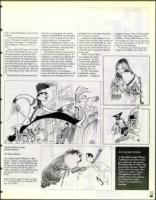
Clockwise from top right:
Barbra Streisand
The Marx Brothers
Zero Mostel and Eli Wallach in "Rhi-
noceros" (1961). Says playwright Arthur
Miller: "People in a Hirschfeld drawing
all share the one quality of energetic joy
in lift' that they all wish they had in
reality. Looking at a Hirschfeld drawing
of yourself is the best thing for tired
b lood. "
Robert Preston played the title 2haracter
in "The Music Man" in Meredith Will-
son's 1957 show.
ON OUR JNE COVER:
Al Hirschfeld caught Inoopi
Goldberg in one of her many
guises from her one-woman
Broadway show in 1984. This
portrait has the most "Ninas"
of any of his drawings. Since
1960, at a reader's request,
Hirschfeld has noted the
number next to his name to
let us know how many
"Ninas" we can find in a
drawing.
4/24
1998