

iTNEntertainment
The Line King
An interview with the legendary Al Hirschfeld.
land. My mother got a job at a depart-
ask him. "The last one," he replies
ment store, and my father, for the
with a grin, while putting the finish-
most part, stayed home with us. He
ing touches on Madonna's long, flow-
was
wonderful."
ing
hair.
"That's
what
I
always
say."
I is 2 in the afternoon on New
Relocating to New York seemed to
Happy
to
share
his
life
experiences,
York City's Upper East Side,
be the right move for the Hirschfelds.
Hirschfeld, who considers himself a
and I'm about to come face-to-
cultural Jew, begins to talk
face with the renowned artist
about his celebrated
who has drawn the most famous peo-
career, and how a young
ple of the 20th century.
boy from Missouri wound
The housekeeper answers the door
up as one of the country's
of Al Hirschfeld's stately pastel-col-
most famous artists.
ored brownstone, and after taking
Born in 1903 in St.
my coat, she directs me up four steep
Louis, Hirschfeld, one of
flights, where I will meet the 94-
three brothers, says he
year-old man behind the pen. An
owes his success to his
electric ramp has been built on the
parents, whose sacrifices
side of the staircase ... "but
made everything possible.
Hirschfeld prefers to walk up and
"My parents had great
down at least two flights each day,"
faith in me," he begins.
the housekeeper tells me.
"When I was very young,
On the climb up, it is hard not to
my art teacher, who took
notice the wall-sized mural behind the
me sketching on week-
piano on the second floor that show-
ends, convinced my par-
cases Hirschfeld's black and white
ents that there would be
,
drawings.
no future for me as an
Bordering the fireplace are more of
artist if I stayed in St.
his favorite caricatures, etched on
Louis. So my parents
square white tiles. A drawing of Bar-
picked up and moved to
bra Streisand, autographed by the
New York — without
famed singer, is also in plain sight.
[having] a place to live or
Upon reaching the top floor, I spot
a means of support."
Hirschfeld sitting at his drafting table.
He pauses a moment to
He is finishing a drawing of Madonna
reflect
on his parents. "My
for an upcoming issue of Rolling Stone.
father,
Isaac
Hirschfeld,
When he sees me, he smiles, then
came
from
Albany
and
leans back in the deep-red adjustable
spoke only English. When
barber chair, where he comfortably
he met my mother, Rebec-
creates his theater drawings for the
ca Rothberg, she had just
New York Times.
come over from the
Hirschfeld, with his long white
Ukraine and spoke Yid-
beard and thick white mustache, is
dish. Yet, they met, fell in
surrounded by hundreds of his own
love, got married and
images. Hanging behind his desk is a
went
on to have three
color sketch of Sonny and Cher that
children.
cover
spot
in
the
TV
Guide's
earned
"My mother was a pio-
1970s.
neer and, in fact, the
Dozens of other familiar faces,
bread winner, which was
along with prestigious awards and
very
unusual in those
family photos, adorn the walls. Stacks
days,"
Hirschfeld contin-
of newspapers containing his artwork
ues.
When
we arrived in
are neatly piled high on the book-
Manhattan,
we hopped on
shelves.
the Amsterdam Avenue
"Do you have a favorite drawing?" I
street car at Penn Station
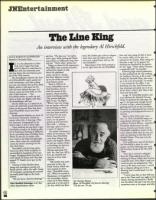
Top: Marilyn Monroe
and took it to the end of
Alice Burdick Schweiger is an Ann
Above: Al Hirsch feld: His favorite drawing?
the line, which was farm-
"The last one," he says.
Arbor-based freelance writer.
ALICE BURDICK SCHWEIGER
Special to The Jewish News
,
4/24
1998
98
Not only was young Al able to hone
his artistic skills, but he also was
exposed to the theater. After seeing his
first play at age 14, his passion for
drawing was matched by his passion
for the stage. "That's when I became
a vaudeville buff," he chuckles.
Following high school graduation,
his first professional job was working
for Goldwyn Pictures, at $4 a week. "I
worked for Howard Dietz, who went
on to do a lot of musicals," he recalls.
"I ran errands for the office. I was
sketching one day, and Howard saw
[my drawing] and asked me to do an
ad for them, which I did. Then I did
more and more ads."
At age 18, Hirschfeld landed a job
as art director for Selznick Pictures,
where he perfected his drawings. By
age 21, he had saved enough money
to move to Paris, where he studied
painting and lived on the Left Bank.
However, he subsequently lost interest
in painting and recaptured his love of
the line.
Back in New York a few years
later, in 1926, Hirschfeld began cre-
ating theater drawings. He and his
publicist, Richard Maney, attended a
Broadway performance by well-
known French actor Sacha Guitry.
Hirschfeld scribbled a sketch of the
actor. Maney liked what he saw and
took the drawing to the New York
Herald Tribune. They ran it in the
Sunday paper.
That publication opened the doors
for Hirschfeld to draw for other
papers, and the following year came
his fortuitous break at the New York
Times.
"One day I received a telegram
from the Times asking me to do a
drawing of Harry Lauder [the Scottish
vaudeville star]. They liked it and con-
tinued to give me assignments. This
went on for about two years. I would
get a telegram asking me to do a
drawing, and I would hand it to the
doorman.
"I never came face to face with any-
one at the Times until one night at the
theater, during intermission, I finally
met the editor. He said I was the most
mysterious man at the paper, and after