
ktf k, 11'
Love Notes
Richard Bernstein brings his bass-baritone
to the MOT in "The Elixir of Love."
SUZANNE CHESSLER
Special to The Jewish News
I is opening night for the opera
The Marriage of Figaro in
Chicago. The star takes ill, and
the understudy steps into the
title role. Critics are wowed.
The plot may sound like an old
movie, but not for Richard Bernstein,
who, in this case, was the understudy.
His story is as new as this year, corn-
ing just before next month's appear-
ance in The Elixir of Love for the
Michigan Opera Theatre (MOT).
Bernstein, 31, already building suc-
cesses with classical performances,
considers the Chicago experience as
his best. Had he been called to take
over any other night, he wouldn't have
received the press notices he did.
"When I first found out [about the
opening], I tried to relax," said the
bass-baritone, who portrayed Figaro
last season for MOT. "I had never
worked with anyone in the cast, and I
4/24
1998
102
had never been on the set. I had no
rehearsals.
"I met with the assistant director,
and we went through every specific
thing that I had to remember and do
in each scene. The opening also was
the radio broadcast of the
production with Zubin
Mehta conducting, and he
made me feel very com-
fortable.
"I never went on again
for that production, but I
got great reviews and was
very pleased. I was thrilled
to have gotten the oppor-
tunity of my life, and I
was happy [the star] got
better because I don't wish
sickness on anyone."
Figaro, which is becom-
ing Bernstein's signature
role, takes him to New
York's Metropolitan Opera
in the fall.
Before that, he will
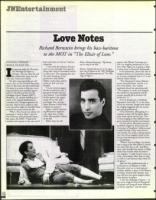
Below: Richard Bernstein: "My dream
was to sing at the Met."
Bottom: Richard Bernstein in his signa-
ture role of Figaro in the 1997 Michigan
Opera Theatre production of "The Mar-
riage of Figaro."
appear with Placido Domingo in a
new Los Angeles production of Car-
men. After Figaro, he is going to Italy
to play Assur in Rossini's Semiramide.
In the meantime, there's the role of
Sergeant Belcore in Donizetti's roman-
tic comedy scheduled May 9-17 at the
Detroit Opera House.
"The [character's] name, Belcore,
means beautiful heart, and he is in
love with Adina," the vocalist
explained about his upcoming role.
"The sergeant is cocky and arrogant.
He thinks he's the greatest and all
women should fall at his feet. He
thinks he's 'it."'
A lot of people got to thinking
Bernstein's voice had "it" at the time
of his bar mitzvah. People who heard
his singing suggested that he investi-
gate going professional.
In his mid-teens, after going to a
classical recital with his father, Bern-
stein knew opera was for him. The
woman singing at that definitive pro-
gram became his teacher and mentor.
On her advice, Bernstein earned a
bachelor's degree in music from the
University of Southern California and
studied in Italy. There were honors
and awards, too, such as being named
the City of Los Angeles Artist of the
Future and winning the Enrico Caru-
so Scholarship.
"When I was in college, my dream
was to sing at the Met before I turned
30, and I did that at 29," said Bern-
stein, who brought his talents to High
Holy Day services while he lived in
Los Angeles. "I really haven't come up
with a new dream other than to sing
as well as I can because that's what it's
all about."
After his first professional role, a
small part in La Boheme in 1986,
Bernstein went on to international
acclaim, thanks, in part, to his fluency
in Italian, French and German. Ital-
ians will not cast opera singers unless
their diction is perfect.
"I like the challenge of opera — to
get up on stage in front of thousands
of people and bring all these different
art forms together," said the opera
Scanned image of the page. Keyboard directions: use + to zoom in, - to zoom out, arrow keys to pan inside the viewer.
April 24, 1998 - Image 102
- Resource type:
- Text
- Publication:
- The Detroit Jewish News, 1998-04-24
Disclaimer: Computer generated plain text may have errors. Read more about this.