

BooKs
See Me, Feel Me,
Touch Me, Heal Me
In her new book, Detroit native Joyce Golden Seyburn offers
a "mind-body approach" to parenting.
Elizabeth Applebaum
AppleTree Editor
oyce Golden Seyburn is a
graduate of Wayne State Uni-
versity and a former teacher
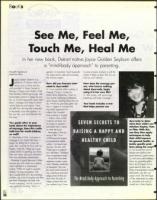
and journalist. In Seven Secrets to
Raising a Happy and Healthy Child
(The Berkeley Publishing Group), she
encourages parents to apply Ayurve-
da, an ancient approach using medi-
tation, massage and herbs to attain
natural balance and peace. Here,
she tells how she became interested
in Ayurveda, how she applies it in
her own life, and what benefits she
has seen.
You speak often in your
book about the importance
of massage. Does this really
hold true for small children,
as well?
A: Absolutely. In fact, I just gave a
massage to my 3-year-old niece. I
began by telling her to close her
eyes, then I traced her face with my
fingers. I told her, "Keep your eyes
closed while I'm painting your face,
then your eyes, and your shoulders."
She was absolutely mesmerized ...
Massage is good because it helps
remove gas and works as a relaxer
when applied in a downward
motion. When it's used in upward
strokes, it brings stimulation. We
don't usually think of it, but crawling
children use a lot of muscles and they
get tired. Massage can help with
muscle cramping, and of course it's
very good for bonding. Touch, in
4/17
1998
70
general, is important. Touch expands
the baby's brain cells and increases
the immune system.
to jump at every moment to call the
doctor. It helps us learn that we can
trust our own intuition.
How did you become inter-
ested in Ayurveda?
A: I was inspired while working at
Deepak Chopra's Center for
Mind/Body Medicine. I had my
own health challenges [diabetes],
and I began reading about Ayurve-
da. When my granddaughter was
born, I began to consider the
Ayurvedic approach for
infants. But I couldn't
find anything in English
— there's some written
material out there, but
it's mostly in Sanskrit —
and that's how I came
to write the book.
Ayurveda is "the sci-
ence of life." It's a
5,000-year-old system,
a preventative health
system. I've heard peo-
ple say, "It's that old?
What use is it today?"
but I tell them, "Wisdom
has no expiration date."
It's not that Ayurveda
replaces modern medi-
cine; Western medicine
is important. This can
be used hand-in-hand if
we would just acknowl-
edge some of the wis-
dom from the East. It
helps us learn that we
[as mothers] don't have
How does the average par-
ent, who knows nothing
about Ayurveda, begin
using it in her own life?
A: Start simply, with some yoga
breathing and baby massage.
Your book includes a test
that helps parents use
Ayurveda to deter-
mine their child's con-‹
stitution: Kapha, Vata
or Pitta. With this,
can they then apply
techniques to help
their child improve
his general health, or
tackle specific prob-
lems along the way?
A: I've found that a lot of
babies are Kapha [with
good stamina, great memo-
ry, and calm personalities]. I
know my granddaughter
has a lot of Kapha, but a
great deal of Vata, too.
[Vata characteristics include
enthusiasm, dry skin, an
active mind. The third type
is Pitta, described as order-
ly, articulate and smart.] I
myself am a Vata Kapha;