
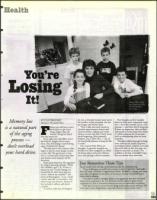

Anna, Alex, Andy
and Jason test Kate
laC01/S fillet 101'J'
every day.
Memory loss
is a natural part
of the aging
process
don't overload
your hard drive.
r
RUTHAN BRODSKY
Special to The Jewish News
fifteen-year-old Stacy enters
the kitchen to get some-
thing, forgets what she
wanted, shrugs her shoul-
ders and moves on.
Forty-eight-year-old Jeffrey enters
the kitchen, forgets why he came
there, fears he's losing it and showing
signs of Alzheimer's disease.
The bad news is that memory does
beginfto slip for some people as early
as their 40s. The good news is that
this is a normal part of growing older
and doesn't mean being at risk for
dementia.
Katie Jacob keeps her life organized
by using a planning calendar. "With
four children, ages 7, 8, 10 and 1 1 ,
there's no way I could manage our
household, let alone keep appoint-
ments, without my calendar," said
Jacob of Birmingham. "I use a small
version and take it everywhere, even
when we go out-of-town, because it
has everyone's address and phone
number.
"I used to make lists of things to
do, but as the kids became more active
the number of lists increased, the lists
got longer, and I'd lose them.
"Now I take time each month to
schedule appointments, lessons and
school activities, making sure every-
thing is current and then I don't worry
about forgetting. [Her husband],
Stephen, uses a Palm Pilot — one of
the hand-held planners to keep his life
in order."
Our internal Palm Pilots are
thoughts. In general, thoughts are
divided into three categories in which
the brain selects and stores informa-
tion, each serving a distinct purpose.
Our thoughts are first bandied
about in short-term, temporary mem-
ory — for a few seconds, up to a few
minutes — and then they're forgotten.
If some are important, they are filed
and stored in recent long-term memo-
ry, which preserves the recent past
such as remembering what we wore
yesterday.
Thoughts which never get to long-
term memory are usually forgotten.
According to brain research, memories
that stick with us after five years are
likely to stay with us always. The
problem is we may eventually forget
how to retrieve those memories.
just Remember These Tips
Social worker Jerri Litt has seNreral practical tips for remembering:
"Keep challenging yourself and continue to learn," says Litt, and make
lists and keep a calendar or appointment book. Establish a routine and keep
your keys and glasses in one place in the house because then you'll notice
when they're missing.
"Use post-it notes in strategic places or on papers so that you can recall
what you're supposed to do. Pay attention and be selective about what's
important for you to remember because no one can remember everything.
And then try not to worry because being anxious about your memory will
only lead to more forgetfulness. especially if you're tired or under str es s."
4/10
1998