
Beth Abraham Hillel Moses
(248) 932-3766
Beth Achim
(248) 357-29106
B'nai Moshe
(248) 788-0950
re
,.)
<
Jewish Community Center
(248) 661-5151
Under Supervision of the Council of Orthodox Rabbis
n
ei4horitood Center
wit"
<
• Attitude
Stevie
C onvenience
• 40 S4opolServico
p4:44,isti
ti
•4 ►
` .
14 ti
'••1 4 '
■••
1);
ORC •4
MALL
WEST BLOOMFIELD • MICHIGAN
Orchard Lake Road • North of Maple
(248) 851-7727
181 S. Old Woodward Ave.
(1 BIk. S. of Maple,
Next to the Birmingham Theatre)
(248) 642-1690
Mon.—Sat. 9:30 a.m.—S:30 p.m.
Dont=
JEWISH NEWS
4/3
1998
82
"
TN
CLASSIFIEDS
GET
RESULTS!
Call
(248)354-5959
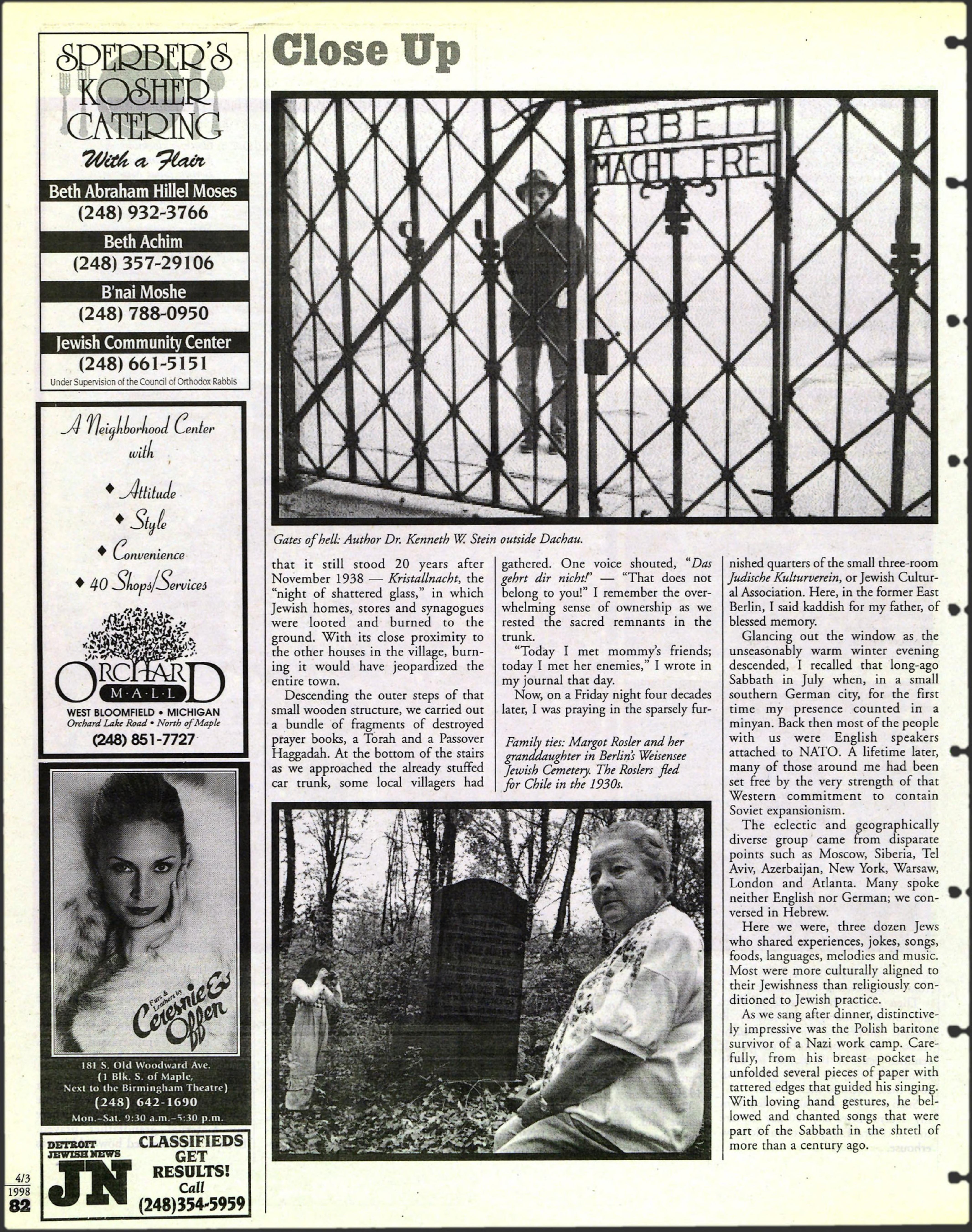
Gates of hell: Author Dr. Kenneth W Stein outside Dachau.
that it still stood 20 years after
November 1938 — Kristallnacht, the
"night of shattered glass," in which
Jewish homes, stores and synagogues
were looted and burned to the
ground. With its close proximity to
the other houses in the village, burn-
ing it would have jeopardized the
entire town.
Descending the outer steps of that
small wooden structure, we carried out
a bundle of fragments of destroyed
prayer books, a Torah and a Passover
Haggadah. At the bottom of the stairs
as we approached the already stuffed
car trunk, some local villagers had
gathered. One voice shouted, "Das
gehrt dir niche — "That does not
belong to you!" I remember the over-
whelming sense of ownership as we
rested the sacred remnants in the
trunk.
"Today I met mommy's friends;
today I met her enemies," I wrote in
my journal that day.
Now, on a Friday night four decades
later, I was praying in the sparsely fur-
Family ties: Margot Rosier and her
granddaughter in Berlin's Weisensee
Jewish Cemetery. The Roslers fled
for Chile in the 1930s.
nished quarters of the small three-room
Judische Kulturverein, or Jewish Cultur-
al Association. Here, in the former East
Berlin, I said kaddish for my father, of
blessed memory.
Glancing out the window as the
unseasonably warm winter evening
descended, I recalled that long-ago
Sabbath in July when, in a small
southern German city, for the first
time my presence counted in a
minyan. Back then most of the people
with us were English speakers
attached to NATO. A lifetime later, D---‹
many of those around me had been
set free by the very strength of that
Western commitment to contain
Soviet expansionism.
The eclectic and geographically
diverse group came from disparate
points such as Moscow, Siberia, Tel
Aviv, Azerbaijan, New York, Warsaw,
London and Atlanta. Many spoke
neither English nor German; we con-
versed in Hebrew.
Here we were, three dozen Jews
who shared experiences, jokes, songs,
foods, languages, melodies and music.
Most were more culturally aligned to
their Jewishness than religiously con-
ditioned to Jewish practice.
As we sang after dinner, distinctive-
ly impressive was the Polish baritone
survivor of a Nazi work camp. Care-
fully, from his breast pocket he
unfolded several pieces of paper with
tattered edges that guided his singing.
With loving hand gestures, he bel-
lowed and chanted songs that were
part of the Sabbath in the shtetl of
more than a century ago.