
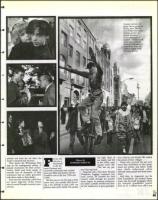

Counter clockwise: A
festive Purim parade in
Berlin; Jonas Mekhers
and Phillip Kein before
Shabbat services in
Berlin's Pestalozzi
Strasse synagogue; a
-Gertnan volunteer with
Action Reconciliation
listens to Holocaust sur-
vivor Moses Grin; the
Yiddish singing group
Michaele Shoene.
.6%
unlocks and locks the ark when the
Torah is removed and returned.
Then there's the Wittenberg Platz
stop on the underground subway. A
placard enumerates the Nazi concen-
tration, death and work camps. It
reminds tens of thousands of daily
commuters that an earlier generation
rode these tracks to their deaths.
Such were the anomalies culled from
my recent three-city 10-day lecture
tour of central Europe's economic pow-
erhouse.
was high. Most of
or me, the
our family had left
Photos
By
visit was a
in the 1930s; some
EDWARD
SEROTTA
benchmark
cousins
never did.
in the dis-
This
was
my par-
tance Germany and
ents'
first
trip
back.
its Jewish community had traveled
Squeezed into a four-door Renault
since my father and mother left the
Dauphirie,
-luggage crammed into
Frankfurt area in the late 1920s and
every
crevice,
we traveled the back
1930s.
country
roads
through my parents'
But this was not my first trip to their
native
region.
In
remnant cemeteries,
native land. Just months after becom-
my
father
carefully
weeded and dust-
ing a bar mitzvah in June 1959, my
ed
the
headstones
of
great-grandpar-
parents, sister and I visited. The anxiety
ents, relatives and friends. We walked
the streets of their villages.
Those who survived the war were
more than astonished as they recog-
nized my mother and father. Some
were clearly embarrassed, others
relieved; many people had both sensa-
tions.
And then, in Angenrod, not far
from Lauterbach, my mother's home
town, was the small synagogue where
my maternal grandfather prayed.
Even at 13, I realized how odd it was
4/3
1998
81