

our independent living pro-
gram for years; now the
approach is to work with
people with very severe dis-
abilities."
Robbie and Dan's home is
the second such JARC place-
ment, Hench said. They
could have been placed in a
group home had one been
available or left to languish
on JARC's considerable wait-
ing list. When the Schechters
stepped in, JARC found a
way to create the best possi-
ble living situation for the
two.
"I thought Robbie would
be with me until I died, or I
thought if I was lucky I'd be
70 [when he was placed],"
said Carol Kaczander, whose
oldest son Eric is a student at
Michigan State University
"Personally, I think that
there'd only be one situation I
could have picked that I
would've liked better, and that
would have been if the home
were in my neighborhood.
But when I dreamed what I
wanted for Robbie, this was it
— that he'd be living with
one other person, with JARC
seeing and hearing about
other group home systems
— in Boston and Michigan.
I know the JARC system,
besides being part of our
Jewish community, is just
the best there is. There's a
basic sense of trust underly-
ing the whole enterprise for
us," she said.
Her sense of relief is
tremendous, for her son and
for her family, including 17-
year-old Amy.
"We've always thought of
this as something fundamen-
tal that he should do, to live
his own life to the fullest,"
Nancy said. "We think it
will be great for him. Since
he's almost 21, we look on
him as a person who is at an
appropriate stage where he
should be out on his own.
We did not want to be in a
situation where we were
elderly people caring for a
middle-aged child at home.
We didn't think it would be
good for us or for him.
Thank God we do have the
opportunity to help Dan
move into a more indepen-
dent life while we're still rela-
tively young, healthy and
active. Every parent with a child with
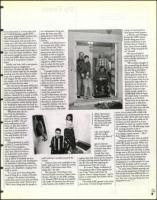
Above: Roommates
disabilities has a fundamental fear about
Robbie Kaczander
where his child will be after they're gone.
and Dan Kaplan in
To have that in place now while we all
the doorway of their
still have our lives ahead of us is just
new home with their
wonderful. It's what my mother would
fathers, Rick and
call a machaya: It's a life-affirming, hope-
Michael.
ful, exciting situation to be in."
Carol described her feelings as "ner-
Left: Dan Kaplan
vous, happy, scared, excited — all of
with his mother
those things rolled into one.
Nancy in the foyer of
"There are so many issues involved
his new digs.
— giving up control is. one. Another is
called life's sucker punches: When you
special needs do:
have a child with special needs, you go
They cobbled togeth-
about your day-to-day business and do
er services that were
what
you need to do, and every so often
available, scant
things
arise in life that almost knock you
though they were.
out
because
they bring home the fact
Unsatisfied with the
that
you
are
not like everybody else;
options they had, they took the situation
your
best
friend's
child enrolling in
in hand, training people themselves to
kindergarten
is
a
sucker
punch; it's your
care for Dan and then applying for
child's
16th
birthday
and
he's not get-
reimbursement from the county
ting
his
driver's
license
is
a
sucker punch.
So it was a "happy confluence of
"In
many
ways
[Robbie
moving out]
circumstances that it came together the
is
the
normal
progression
of
things, but
way it has," Nancy said. From all
this
brings
home
how
different
this is,"
reports, Dan is "casing the joint," and he
Carol
continued.
"He
can't
call
me
and
seems to understand that Robbie will be
say, 'Ma, this is the best thing that ever
his roommate.
"The whole JARCAystem is the creme happened to me.'"
de la creme. I've had enough experience
Photo by Krista Husa
found placement in a home after Jack
and Linda Schechter, regular JARC
supporters, helped JARC purchase the
West Bloomfield condominium, a
bright living space that provides both
young men with their own bathrooms,
a roomy kitchen and living room and
plenty of closet space. Doorways have
been widened and made barrier-free to
make room for Dan's wheelchair. They
will receive round-the-clock care from
at least one JARC direct-care worker,
but the key is to promote indepen-
dence.
Robbie was born with a rare genetic
disorder known as Angelman's
Syndrome. He does not talk, but he
makes his desires clear by, for example,
standing near the door when he wants
to go out or going to the table when
he's hungry He also tends to favor cer-
tain people, and Carol believes he has a
grasp of some abstract ideas.
Dan was born with spina bifida and
myelomeningocele, a neural tube defect
that has compromised his ability to
walk and has impaired his intellectual
abilities. However, he is expert at work-
ing jigsaw puzzles, he has elementary
reading skills, understands sequencing
on the computer, makes choices about
the clothing he wears and the food he
eats, and can recall blocks of words that
are appropriate to a given situation.
"Whatever they can do,
they do for themselves.
The staff will be coaches,"
said Chris Hench, assistant
director at JARC. The pri-
mary staff person at the
house, in fact, has worked
with JARC for a number of
years and is accustomed to
running a kosher kitchen.
Dan and Robbie will both
stay in their respective
schools.
Their placement is a part
of JARC's 5-year-old Home
Of Your Own program,
which evolved from a philos-
ophy that tailors services to
an individual's needs rather
than plugging him or her
into a matrix of available services.
JARC serves people with developmen-
tal disabilities, operating residential
homes and apartments for some 150
people with disabilities ranging from
mild to severe.
"In a way, we've been doing this
kind of thing for a couple of decades
— going to the person and asking
where they want to live and providing
the services they need," Hench said.
"We've been doing that for people in
staff; and that it would be around the
corner.
"I have to have such total faith in the
JARC staff; and I do. I think if it weren't
for JARC, I don't know how I'd be
doing this," she said.
Ten years ago, when Nancy and
Michael Kaplan moved to Detroit from
Boston, they got on the JARC waiting
list. Because JARC doesn't serve individ-
uals under 18, however, they did what
other families with children who have
❑
3/27
1998
9