

L_
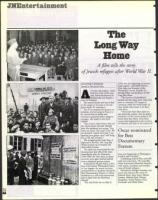
Photo courtesy of the Simon Wiesen thal Cen ter Archives
The
Long Way
Home
.
Photo courtesy of Beth Hatefutsoth
Photo courtesy of VIVO Institute fo r Jewish Research
A film tells the story
of Jewish refugees after World War II.
3/13
1998
84
SUZANNE CHESSLER
Special to The Jewish News
CM1484 - 1
ITEEDOM WM4(11
JEWtSii
n 8-year-old orphan, a frail
- little boy with a little suit-
case, leaves the horrors of
Buchenwald and boards a
train for Palestine.
His natural family had been killed
in the camps so he looks to his reli-
gious family for sustenance.
Too ill to complete his journey on
schedule, the boy stops in France to
be nursed back to health and
becomes acquainted with a religious
teenager, who reads to him from
Ezekiel:
"Son of man, these bones, they are
the whole House of Israel. Behold
they [the skeletons] are saying, 'Our
bones are dried. Our hope is lost. We
are doomed.' Sayeth the Lord, 'I am
opening your graves, and I will bring
you to the soil of Israel.'"
The ravaged youth, Israel Lau, is
depicted in the film The Long Way
Home; he grew up to become the
chief rabbi of Israel.
The rabbi was interviewed for the
documentary that tells of the years
immediately after the Holocaust,
1945-1948, the time when so many
survivors were again behind barbed
wire in displaced persons camps.
Produced by Moriah Films, a divi-
sion of the Simon Wiesenthal Center
in Los Angeles, the movie has been
nominated for an Academy Award for
Best Documentary Feature. It will be
broadcast on a still-to-be-announced
date in April over the Showtime .
channel.
"The end of the war on May 8,
A
Wegtaseausaus
*iliaSpia411 611d1.
1945, was the beginning of another
long tragedy," said Rabbi Marvin
Hier, dean and founder of the
Wiesenthal Center, founder of
Moriah Films and producer of The
Long Way Home.
"The survivors lived behind
_barbed wire for three more years, this
time in American DP camps in
Germany, while the world made up
their minds what [was] to be done
with them.
"There have been films done on
this particular subject, but the global
dimension of this movie makes it dif-
ferent from the others. [Our film]
covers what happened in the territory
of Palestine but only in the context of
Oscar nominated
for Best
Documentary
Feature.
what was happening in Washington,
London and Germany."
Combining archival film and stills
with new interviews, The Long Way
Home interweaves historical narrative
with stories, anecdotes and recollec-
tions of Jewish refugees.
Narrated by Morgan Freeman, the
movie also features the voices of
Edward Asner, Sean Astin, Martin
Landau, Michael York, Miriam
Margolyes, David Paymer, Nina
Siemaszko and Helen Slater.