

Although several Jewish land devel-
opers, particularly the Southfield-
based Farbman Group, were involved
in acquisition of land for the sports
stadiums, it is too early to predict
whether they will play a similar role
for the casino sites. Burt Farbman
stressed his group's acquisitions were
made for the Wayne County Stadium
Authority and involved public, not
private, funds. With two Jewish devel-
opers among the Atwater investors,
land acquisition could easily be han-
dled in-house.
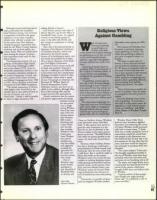
The Detroit-born Deitch, 50, is a
graduate of Mumford High School,
the University of Michigan (1969)
and its law school (1972). Active in
the Jewish community, Deitch is a for-
mer executive committee member of
the Jewish Community Council, and
was a trustee of the Union of Ameri-
can Hebrew Congregations from 1988
to 1991. He is a member of the board
of trustees of U-M Hillel Foundation.
"The Jewish community of Detroit,
while largely today domiciled in the
suburbs, has its mots planted firmly in
the city of Detroit, just as I do,"
Deitch said. "I think it will be possible
for them to align themselves with
making Detroit a success."
Like Deitch, investor Alan May of
May & May P.C. has his law offices in
Southfield's Town Center. An original
investor in the Atwater group, he
came to the table with Deitch, and
later served as a consultant in writing
Proposal E.
May, who is the national Jewish co-
chairman of the National Conference
of Christians and Jews, said he was
attracted to the Atwater project
because of its development aspect, and
not merely the potential for a casino.
He is a former chairman of the Michi-
gan Civil Rights Commission.
Atwater's road to success could still
be lined with potholes. Proposal E
may face a challenge at the ballot box
in November from the Lansing-based
Michigan Interfaith Council on Alco-
hol Problems, which seeks to repeal
the law. The group's co-chairman, the
Reverend Dr. William Quick of
Detroit's Metropolitan United
Methodist Church, said there are no
rabbis in the coalition, although Allen
Rice of the Lansing office said he
would welcome their participation.
Deitch's prediction that the casinos
will present opportunities for Jewish
business owners
has not proved
true in neigh-
boring Windsor.
Part of the man-
date of the two
interim casinos
(the Northern
Belle Casino
Riverboat and
Casino Wind-
sor) was that
they revitalize
Windsor's City
Centre area.
Some Windsor
city council
members say
they have failed,
and suggested
revoking the
agreement for
the under-con-
struction perma-
nent casino.
One of
Windsor's best-
known Jewish
merchants is
Jack Shanfield of
Shanfields-Mey-
ers Jewelry and
Alan May:
Atwater investor.
Religious Views
Against Gambling
hile Muslims and
Protestants generally
see gambling as an
intrinsic evil, main-
stream Jewish and Catholic ideology
see gambling as an act that can lead
to evil, and eventually become
addictive, especially if the gambler
becomes indebted as a result of his
losses.
Explaining Halachic tenets on
gambling, Rabbi Joseph Krupnik of
the Council of Orthodox Rabbis of
Greater Detroit said gambling is
considered the equivalent of stealing
or robbery:
"In gambling, a person goes to
win, not to lose. If money changes
hands through a form of thievery, it
is not good. If you lose, yoli: do not
really want to lose, and you <do not
want to leave your money behind. It
is not good when money goes from
one person to another without good
will."
But what about bingos and Las
as _style (an d soon to be Detroit-
quill() nights at synagogues?
lieves there are exemp-
occasional' bingo or
n. But he stressed that
W
China on Ouellette Avenue, Windsor's
main downtown artery. Said Shan-
field, "It (the casinos) may not be as
good for other businesses as it has
been for us, but we advertise in the
Detroit market so the casino patrons
know we are here." Shanfield believes
that while one person gambles at the
casino, his mate looks around down-
town.
However, where Ouellette Avenue
less than a decade ago could boast a
preponderance of Jewish-owned retail
businesses, there are now at best only
a half-dozen. But it would be unfair to
blame that solely on the casinos.
Windsor's entire City Centre has lost
retailers to outlying shopping centers
while gaining entertainment and hos-
pitality venues. In the process, Ouel-
lette, and even Pelessier Street, once
Windsor's version of Detroit's Wash-
ington Boulevard, have become an
area of boarded-up stores and parking
lots.
"Downtown is a terribly sad place,"
said one longtime Windsor resident.
high-stakes casino games are differ-
ent.
The Council of Orthodox Rab-
bis issued a statement opposing
casino gambling in Detroit. The
rabbis said gambling is addictive
and cited its negative impact on
families.
"We know in many cases of
divorce, a factor that was included
was one partner's tendency to gam.-
ble. We know of companies built up
over years of hard work that were
lost in short periods of time because
of gambling. We know of cases
where numerous wrongdoings hap-
pened to feed a gambling addiction,
such as stealing from families,
friends and partners," the rabbis
said.
"None of these are acceptable sit-
uations in Judaism. They are realis-
tic possibilities from the growth of
casinos."
Even the Mishnah warns of the
evils of gambling. "It states that a
man who is a dice player cannot be
regarded as a valid witness because
he has no credibility," said Rabbi
Jeffrey Ableser of Windsor's Temple
Beth El. 0
.
Windsor Mayor Mike Hurst
believes some merchants deluded
themselves into believing the arrival
of Casino Windsor would automati-
cally lead to boom times. "I think .
there was a totally unrealistic level of
expectation created by several busi-
ness people in the downtown area
who believed that all they had to do
was operate in the way they have for
years, and there would be long line-
ups of people to purchase their mer-
chandise.
"The casino industry," Hurst said,
"has brought magnificent benefits to
the city of Windsor. Some have done
extremely well, some have done well,
and some are not benefiting well at all."
The mayor said single-family home
construction has skyrocketed with the
arrival of the casinos, which have
brought 8,000 direct and indirect jobs
to Windsor.
"A good number of these people
have bought new single housing,"
Hurst said. "It is definitely a case of
cause and effect."
2/27
1998
97