

Close Up
Detroit side of the river, casinos would
not have happened without Larry
Deitch.
In late 1994, Deitch was asked by
Nellie Varner to become involved with
the Atwater group. The two shared a
common history: Deitch was elected
to an eight-year term on the Board of
Regents of the University of Michigan
in 1992, and Varner served 16 years
on the board.
Deitch immediately began develop-
ing Atwater's strategy, and in early
1995, Atwater struck a joint venture
deal with Mirage Resorts to build a
casino. Atwater's responsibility was to
get the license. When Michigan Gov-
ernor John Engler announced his
opposition to casinos in June 1995, he
recognized that Detroit Mayor Dennis
Archer, who by that time was support-
ive of casino gaming, had the preroga-
tive to go to the Legislature. Engler
insisted that any legislation include a
referendum of the people.
"The conventional wisdom was
that this was defeat, and there weren't
going to be casinos in Detroit," said
Deitch. "We saw it as an opportunity,
because we needed legislation anyway,
and the governor had raised the ques-
tion of taking it to the people.
"It was our belief that a majority of
the people in Michigan would support
gaming."
Mirage dropped out, so Atwater cut
a deal with the Greektown interests to
work together. Deitch was asked to be
legal counsel and write the measure
for putting the question on the ballot.
"So we drafted Proposal E and
began in March 1996 to circulate a
petition. For a lawyer, it is an extraor-
dinary opportunity to write a law and
to shape public policy," said Deitch. A
partner with the Southfield-based Sey-
burn, Kahn, Ginn, Bess, Deitch and
Serlin PC, Deitch's specialty is corpo-
rate and real estate law.
Again, conventional wisdom said
they would fail to get the required
247,000 valid signatures. But within
90 days, they submitted 420,000 sig-
natures and were certified to go on the
Watching Out
For The Jews
ccording to Rabbi Joseph
Krupnik of Windsor's
Orthodox Shaarey Zedek
synagogue, 'Windsor's tiny
Jewish community has a unique way
of heading off potential Jewish prob-
lem gamblers.
"That's because Betzalel Folk, the
president of Sh2ir Hashornayim
(another Windsor Orthodox congre-
gation), is a supervisor at Casino
Windsor. That way, we have a
tremendous advantage over most of
the communities," said Krupnik, .
who works for the Council of Ortho-
dox Rabbis of Greater Detroit in
Southfield:
"We can keep potential problem
gamblers from the Jewish communi-
ty awaY from the casino tables. It
would be widely known in
i the
Windsor Jewish community if some-
one has a gambling problem," said
K.rupnik.
But there's another side to Krup-
nik's theory Said Folk, "We're not
allowed to say who we see at the
tables, or didn't see. It is all very dis-
crete."
And Folk, who has been with the
casino since it opened, doesn't work
2/27
1998
96
on Shabbat. Casino Windsor fully
recognizes Folk's Sabbath observance
and accommodates it.
Said Rabbi Jeffrey Ableser of
'Windsor's Temple Beth El, "Truth
fully I thought there would be at
least three schnorrers a week after the
casino opened. But that hasn't hap-
pened_."
Rabbi Aaron
gation Be th
Wesi
lei
halls
rnunity than
abuse- But, he believes
some time before Detrd
effects.
"Four or five years from'
when people start losing their homes
[because of gambling debts], then
we'll feel it."
Rabbi David A. Nelson of
gregation Beth Shalom in Oak P
believes most Jews who gamble pre-
fer sports betting to casinos. A book-
ie told Rabbi Nelson several years
ago that a substantial number of Jews
took cellular phones to synagogue on
Yam Kippur in order to place bets on
football games during the afternoon
break. El
ballot. To get
those signatures
meant hiring an
outside firm,
National Peti-
tion Manage-
ment Inc., of
Roseville, Calif.
National and
two of its key
executives are
listed among
the investors
who have a
piece of Atwa-
ter's action.
In November
1996, following
an extensive
advertising
campaign, 51
percent of
Michigan voters
approved Pro-
posal E.
The predom-
inantly African-
American Atwa-
ter group
includes Walter
E. Douglas,
president and
majority stock-
holder of Avis
Ford in South-
field; Los Ange-
les attorney
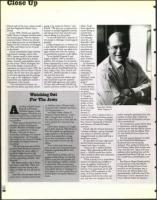
Lawrence Deitch:
Wrote Proposal E.
Johnnie L.
Cochran Jr., of O.J. Simpson fame; a
number of Chaldean business people
with businesses in Detroit; Michigan
Rep. Samuel Thomas III of Detroit;
and between 120 and 140 other
investors.
Deitch calls the Atwater investors a
"rainbow coalition, a group of people
who believe in Detroit, and who
plugged forward on what itself was a
speculative venture."
He says there are many opportuni-
ties for Jewish entrepreneurs as the
casinos inch closer to reality.
"These are $5 7 million develop-
ments. We're planning an 800-room
hotel, a 100,000-square-foot casino.
There would be about nine restaurants
in it, plus retail space.
"There is going to be a tremendous
amount of opportunity available in
terms of suppliers of all kinds of
things. Think about the goods and
services. Our projections are we will
have about 3,800 employees at the
jump. So if you assume similar
-
employment levels by the other casi-
nos, and then you recognize the eco-
nomic multiplier generated from that
number of direct jobs, I think the
opportunity for the business commu-
nity is tremendous."
The Greektown casino will be built
in Greektown, and the speculation
until last week was that MGM Grand
would end up with the Edison Plaza
site and Atwater/Circus Circus was
unresolved.
The city wanted Atwater to build
in the Grand River/Washington
Boulevard area, but the group
declined. They preferred behind the
Fox Theatre (where Park Avenue now
runs) near the new Tigers and Lions
stadiums, their parking lots, and the
proposed Hard Rock Cafe site, to cre-
ate a world-class entertainment com-
plex.
But Detroit Mayor Dennis Archer
announced last week that MGM
Grand and Atwater/Circus Circus
would be in the Rivertown area, a
block from the Detroit River and
approximately a half mile east of the
-
Renaissance Center. Atwater/Circus
Circus officials hailed the decision.