

The BiG Story
Kitchen Helpers
Can Have Fun, Too
Sharon Manello Borstein
Special to The AppleTree
y 6-year-old son can cook.
Nothing gourmet, mind
you, and he needs help,
but he knows the difference between
a whisk and a spatula.
He's most accomplished at (big sur-
prise) dessert, because that is what
he likes to eat, but he can help with
other parts of the meal.
Since he was old enough to stand
on a step stool, Sam has been help-
ing in the kitchen. In addition to the
basic skill of preparing food, reading,
math and following directions can be
developed in the kitchen. Lest you
worry that you don't know enough
about cooking, you needn't be Julia
Child to pull this off. Just keep in mind
a few basic guidelines:
1. Keep it simple.
Want to use a mix from a box? Go
ahead. Make something with a limit-
ed number of ingredients and just a
few steps for preparation.
Children have a short attention
span. This is not the time to try that
wonderful salmon in puff-pastry recipe
you clipped from the gourmet maga-
zine.
2. Make something the child will
enjoy eating.
Especially for first tries in the kitchen,
you'll find the child will be most enthu-
siastic about cooking a favorite dish.
Later, you can get sneaky and try
introducing other foods. Most often, if
children have helped to cook it, they'll
at least give it a taste! Sam and I
started with baking .brownies (he
loves anything chocolate) from
scratch. They are easy and tasty.
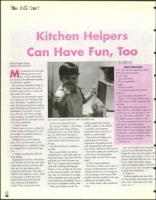
Sam knows a good brownie when he makes one.
3.Don't worry about the mess.
Yes, having a "helper" in the kitchen
usually does mean things will get a
bit messier than if you were working
solo. So what? You're having fun,
right? Also, this is a wonderful oppor-
tunity to teach about cleaning up as
you go.
4. Let the child be as involved as
possible.
Very young children can dump
ingredients into a bowl after they are
measured (using a big bowl will help
make their aim more accurate; see
#3). This is a great way to introduce
math skills including counting and
fractions. They can help stir, too. Later,
as they become familiar with ingredi-
ents, they can hand them to you (get
all the ingredients out on the counter
at the beginning of cooking). This is a
nice way to strengthen reading skills.
Other good beginning jobs are
Sam's Brownies
1/2 cup melted margarine or butter
3/4 cup cocoa powder
2 cups sugar
1 cup unsifted flour
1/4 cup vegetable oil
4 eggs
1 teaspoon vanilla
I cup chopped pecans or walnuts
(optional)
1 cup semisweet chips (optional)
Grease a 9x13 pan. Preheat oven
to 300 degrees. Melt margarine and
set aside.
Mix together the cocoa powder,
sugar and flour. Add the oil, eggs and
vanilla and mix well by hand or with
a mixer. The batter will be thick. Add
the meited margarine and mix well.
Pour into prepared pan and top with
*nuts and/or chocolate chips if
- desired. Bake for 45-50 minutes. The
shorter time will yield a fudgier brown-
ie; test with a toothpick for doneness.
If the pick comes out clean but a little-
moist, the brownies are done.
Cool and cut.
rolling matzah balls, shaping
challah "snakes" to be braided
or spiraled, and scooping
ingredients into a pan (say for
potato or noodle kugel).
More advanced helpers can
read recipes and do food
preparation like peeling carrots
and chopping fairly soft ingredi-
ents such as mushrooms and zucchini.
Start with a plastic picnic knife and
work up to a real paring knife;
always make sure the child is super-
vised.
5. Don't expect perfection.
The fun for a child is not so much in
having a finished product worthy of
culinary awards as it is in having fun
with the process. Don't worry if the
cookies look like amoebas or the veg-
etables are not perfect cubes.
6. Within reason, allow experimen-
tation.
t
Sam got the idea to put chocolate
chips on top of the brownies, even
though that was not in the recipe. The
brownies were a big hit; in fact, we
always make them that way now. So,
if your child wants raisins, poppy
seeds and sesame seeds on the chal-
lah, give it a try. You just might inver c+_ _/ \
a great new combination.
7. Have fun.
Cooking together with your child
can be relaxing, educational and cre-
ative. And, maybe best of all, deli-
cious, too. ❑
-