

tWeineinber the
tqPeat g;;IleN,
g- opeueit.
Photograph). Inc.
31543 W. 13 MILE RD.
D ShiN
It Up
coffee like it used to be — that is to
say, dishwater (I can't remember if it
had the added bonus of froth as
well). Sure, it was dreadful, but as
far as nostalgia goes, it was price-
less.
While I don't believe it's fair to say
the British don't know how to eat
well, it's certainly true that food does
not play a significant role in our cul-
tural landscape, as is the case with
France, Spain or Italy. -
There, food is associated with
pleasure; here, it has a more func-
tional purpose, and the cheaper
and quicker the whole wretched
business can be got on with, the
better.
Yorkshire
Pudding
4 oz. flour
Half-pint water
2 Tbsp. pareve margarine
2 eggs
1/2 tsp. salt
FARMINGTON HILLS
Sift flour and salt into bowl. Make
a well in the center, break in eggs
and 2 Tbsp. water. With a wood-
en spoon, stir in a little flour from
sides. Keep stirring, gradually
,--/
adding more water until half has
been used. Mix to a smooth bat-
ter free of lumps and beat lightly.
Add remaining water and let
stand for half an hour. Put mar-
garine in a shallow, fireproof dish
or baking tin and place in oven
until smoking hot; then pour in
batter and bake in a hot oven for
30 minutes. It can be served in
the dish in which it was cooked
or cut in pieces and set around
the meat.
(248) 553-4867
Seasonal Sale
Shoes and
,Handbags
25.50% Off
Anc
MICHAEL A, JONAS
PHOTOGRAPHY
Certified Professional Photographer
Specializing
In
Weddings
Bar/Bahlitzvahs
And Fine Celebrations
BIRMINGIaM, MICHIGAN
(248) 647-5060
"The Difference IS The Difference!"
DVI'ROIT
JEWISH NEWS
1/30
1998
70
CLASSIFIEDS
GET
RESULTS!
Call
(248)354-5959
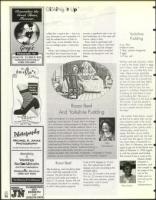
Sally Tannenbaum is a busy professional for whom
cooking is not a priority. A nurse, she is in charge
of a community nursing program in Surrey, which is
close to London. Sally, whose husband, David, is a
building contractor, finds she only has time to cook
properly on the weekend. That's when she'll likely
settle down for a couple of hours with a nice joint
(of meat, that is). Bearing this in mind, she has sup-
plied this recipe for a traditional English favorite,
roast beef and Yorkshire Pudding. For those who
have not come across it before, Yorkshire Pudding is
a kind of pie made chiefly from flour and should
always be eaten with roast beef. Incidentally it originates in France
shire England
and not, as one would have surmised, from York
Roast Beef
After koshering, meat should be dried
with a cloth kept especially for this
purpose. The joint should be of a
good cut and quality and weigh at
least 2-1/2 pounds. Season with salt
and pepper and place in a roasting
tin with a little pareve margarine.
Cook at 475 degrees for 10 min-
utes. Then reduce heat to 400
degrees and cook according to the
timetable below:
Thick cut: 30 minutes to the pound.
Thin cut: 25 minutes to the pound.
Serve with roast potatoes, grated
horseradish, and of course,
Yorkshire Pudding.
My mother, Nora Keren, would
be the first to admit she's not the
most creative cook in the world.
Having been for many years the
beneficiary of her culinary skills I,
unfortunately, would have to
agree. But then, as my mother
would quickly point out, she had
to work from the age of 16 and
has never been a housewife as
such. Born in Germany, she man- c/
aged to get out to the British man-
date of Palestine in 1938 togeth-
er with her parents and brother.
She trained to be a nurse at the
Shaare Zedek
Hospital in
Jerusalem, and
was caught in
the siege of the
city by the
Arabs prior to
and during the
War of
Independence.
Nora Keren