

Changing Image
Pawnshop History
ALAN ABRAMS
Special to The Jewish News
he three large balls hanging
outside the pawnbroker's
office are long gone, but
pawnshops are very much
alive and flourishing in metro Detroit.
And like many other businesses that
have successfully found a niche in the
specialized '90s, pawnshops have gone
upscale to attract and service a new
breed of clientele.
You won't find guitars and rifles
hanging from the walls at Norman's
Jewelry & Loan on Telegraph Road near
Nine Mile Road in Southfield. Instead,
a display case highlights unique trea-
sures such as a team-signed Detroit
Pistons championship basketball and a
1984 Olympics gold medal.
Last November, store owners Sharon
and Norman Gornbein consigned an
out-of-pawn baseball autographed by
Babe Ruth to the premier Mastro &
Steinbach sports auction house.
Estimated at $1,800, Bill Mastro con-
firmed it brought $3,800. If you're
interested, Norman's has another one in
stock.
The Gornbeins have made loans on
heirlooms ranging from original art-
works by LeRoy Neiman, Jim Dine,
Peter Max and Picasso to art deco Erte
bronzes. They've loaned on Harley
Davidson motorcycles, Wurlitzer organs,
fine furs and cars.
"The only car we haven't pawned is a
Rolls Royce," said Norman Gornbein,
"but we've had 98 percent of the other
makes in our possession."
Yet, it is still gold and diamond jew-
elry that is the mainstay of the new
breed of pawnshops like Norman's.
Why? "It's always a material you can
scrap, and it's got a cash-out value.
That's still what the bank looks at first,"
said Sharon Gornbein.
Indeed, their carpeted, well-lighted
showroom suggests the ambience of a
jewelry store more than it does a pawn
shop. Their customers are upscale and
so is the merchandise.
Although the Gornbeins occasionally
will buy jewelry outright, they have cus-
tomers who continuously have renewed
their loans from the day the store
opened in 1993.
The Gornbeins are strict about pro-
tecting the confidentiality of their
Pawnshops of the 1990s
are polishing their looks
while continuing to provide
an age-old service.
-0
0
0
0
awnbroking can be
traced back at least
3,000 years to ancient
China, and references to
it have been found in the earliest
written histories of the Greek and
Roman civilizations.
Usury laws imposed by the
Catholic Church in the Middle
Ages prohibited the charging of
interest on loans, limiting pawn-
broking to those outside the
Church, such as Jews. Out of eco-
nomic necessity and because of
problems in the banking system,
pawnshops made a resurgence in
later years.
The House of the Lombards
operated pawnshops -throughout
Europe with royalty, including
King Edward III of England,
among their clients during the
14th century.
The symbol of the Lombards'
operations were the three infa-
mous gold balls. The Medici fami-
ly also became active in pawn-
broking, and the three gold balls
can still be found in their family
crest.
When Christopher Columbus
approached Queen Isabella about
securing funds for his voyage, she
was prepared to pawn her crown
jewels to provide the financing.
But having driven the Jews out of
Spain, she was fortunate that the
government found an alternate
source of revenue.
The children's nursery rhyme,
"Pop Goes The Weasel," refers to
pawnbroking. A weasel is a shoe-
maker's tool, and in early vernacu-
lar, to "pop" is to pawn. Hence,
"That's the way the money goes,
pop goes the weasel."
In 1988, when the National
Pawnbrokers Association was
formed, there were 6,800 pawn-
shops nationwide. Last year, there
were more than 15,000, making
about $35 million in loans. Some
of that growth is attributable to
four large, publicly-held chains
moving into the arena. The chains
do not have a significant presence
in the metro Detroit area, prefer-
ing to operate in southern states
where they can legally charge as
high as 20 to 25 percent interest a
month. But none of the four has
done particularly well as invest-
ments in the stock market.
.
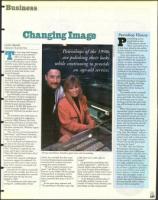
Norman and Sharon Gornbein: good service and surroundings.
clients, but conceded that they count
several professional sports personalities
and automobile company executives
among their pawn customers.
"We have wealthy attorneys to sur-
geons," said Sharon Gornbein, "but
Most are in the middle. We have people
living paycheck to paycheck, and for
them, pawning is guerrilla financing.
Some customers have done it 50 to 75
times."
As one pawn shop customer said,
"The pawnshop is the place to go, espe-
cially when your credit cards are
maxed."
For generations, pawnshops were
unfairly stigmatized — often by anti-
Semitic British crime fiction writers —
as a haven for petty thieves looking to
fence stolen goods. Today's store is more
likely to play an active role in the recov-
ery of stolen merchandise.
As the linking by Miami police of
serial killer Andrew Gunman to the
murder of Gianni Versace showed, most
pawnshops are fully computerized.
1998
137