

Sandler, a 26-year-old political fund-
raiser. "But, for now, my old 1990
Dodge Omni is more my speed."
Old cars, it seems, hold a special
place in even the youngest drivers'
hearts. Whether it's the first car some-
one ever owned or something passed
down from a grandparent, these
clunkers have their own ramshackle
charm that might be high in mainte-
nance, but even higher in personal
style.
Trudi Smith, a 31-year-old market-
ing director, inherited a nondescript •
Ford Escort when her parents decided
to get rid of it and buy another car.
At first, she wasn't crazy about the
ratty tan machine, but soon she start-
ed to add her own idiosyncratic
touches.
"Once I put all my Grateful Dead
stickers on it," she said, "it was all the
more fabulous."
Ultimately, a car isn't. just a mode
of transportation — it's a mode of
being. Cars provide a tiny, enclosed
personal space that serves as a con-
stant throughout the changing days.
As young Jews get older, of course,
they'll soon have to take on. other
considerations: space for kids, airbags,
big spacious trunks.
But, for now, as long it runs and
makes the driver feel good, a car is
the next best friend to, well, a dog. ❑
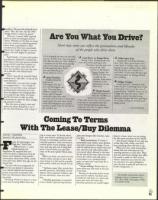
Here's how some cars reflect the personalities and lifestyles
of the peopk who drive them.
A lot of people say that you are what
you eat. If that's true, then you prob-
ably also are what you drive. Below is
a rundown of the five most popular
types of cars that young people
are driving these days. Each
one says something dif-
ferent about its owner.
.
4
Jeep Cherokee
Usually owned by
believers of
Darwinism: The per-
son with the biggest car
wins. The extra space
reflects a couple of dif-
ferent types of people;
outdoorsy types who need
the extra room for skis or tents; and
messy types who just want to pile
week-old newspapers and ancient
laundry in plain view for the rest of
the world to s
Land Rover or Range Rover
Young Urban Professionals who
want the power and space of a
Cherokee, but the style and
status of the '90s
answer to the former
Yuppie champ, the
BMW Drivers love
to talk on car
phones. Even when
someone is not
necessarily on the
other end.
Honda Accord
Especially popular as
sportuysebductar
gs;acptircial
l'e. rs are
They also tend to be a bit less polit-
ical, not so concerned with the
whole foreign/domestic debate.
After all, they like to argue, what's
truly domestic an a
Volkswagen Jetta
Deadheads and Blues Traveler
fans. Very often these drives have
some kind of college radio or eco-
logical bumper stickers. Also they
like the power and control of a
stick shift. If this were 30 years ago,
they'd probably be driving Herbie
the LoveBug.
Dodge Avenger
Loyal, patriotic.ne who
ho
wants to give something back to the
community, but not at the cost of
personal style. Probably been out of
college less than five years. Also,
maybe, a sucker for advertising,
since the Avenger has been getting a
lot of play among the twentysome-
thing crowd.
David Kushner
Coming To Terms
With The Lease/Buy Dilemma,
DAVID J. KNIPPER
Special to The Jewish News
F
orget the champagne, just
"high five" Uncle Sam.
Effective Jan. 1, a new
federal leasing rule,
Regulation M, requires that con-
sumers be given a disclosure form by
lessors (auto dealers) citing specific
information about lease terms, condi-
tions and costs, before they sign on the
dotted line.
The new rule is an outgrowth of
(forts by auto industry representa-
tives, federal officials and consumer
groups to provide consumers with
clear-cut information about how leas-
ing works.
Deciding whether to lease or to buy
is not easy. Leasing differs from buy-
ing in many ways. To decide what's
best, you need to understand the dif-
ference in ownership, up-front costs,
monthly payment, early termination,
vehicle return, excess mileage, excess
wear and tear, and end of term deci-
sions. Lots of terms, you say? Not
clear on the auto-speak? Here's some
help:
When you lease, you don't own the
vehicle; rather, you get to use it and
must return it at the end of a specific
time period, unless you decide to buy
it.
* Up - front costs: May include first
month's payment, refundable security
deposit, down payment (called a capi-
tal cost reduction), taxes and other
fees.
* Monthly payments: Comprised
of the vehicle's expected depreciation
plus rent charges (like interest), taxes
and fees.
* Early termination: If a lease is
terminated early, dealers must disclose
any early termination charges. If not,
and the vehicle has no excess wear and
tear, and the total miles driven does
not exceed what's allowed in the lease
by the end of the term, then you may
return the vehicle and walk away--
or purchase it at a predetermined
price, or enter into a new lease for a
different vehicle.
* Excess mileage: Excess wear or
extra miles may cost extra at the end
of the lease.
Buying, on the other hand, means
you own the vehicle. Up-front costs
include the cash price or a down pay-
ment plus taxes and other fees.
Monthly payments are usually higher
than in a lease, since you are paying
for the entire purchase of the vehicle
— plus finance charges if you take out
a loan. But with a lease, you don't
have anything when the time is up.
When you own, early termination
means that you must pay any out-
standing amount on your loan. Wear
and tear and excess mileage may affect
the resale or trade-in value of your
vehicle. And since you own the vehi-
cle, you have no return obligation;
once the loan is paid off, you have no
further obligations. ❑
For further information abou
leasing, write to Leasecrets, Inc
P.O. Box 3448, Farmington Hills,
MI 48333-3448.
1/9
1998
71