

e Scene
OVA"
m000k.:
DAVID KUSHNER
Special to The Jewish News
.
S
ome people drive sports cars;
some drive trucks; others,
convertibles. Me, I drive a
shul — or at least the auto-
mobile equivalent of a synagogue on
wheels: a 1988 Buick LeSabre. White
exterior as creamy as creamed herring.
A plush red interior the color of
Manischewitz. Everything is com-
pletely electric — the seats, the win-
dows. The only thing that's missing is
a yarmulke dispenser in the glove
compartment.
Despite the features, this probably
would not have been my first choice
of car. I might have gone for some-
thing a little more sporty. But I can't
complain, since I more or less inherit-
ed it from Grandma Darbie, who is
too old to drive it herself.
After I drove the Buick home,
though, it started to grow on me, like
a tired dog who wanders up to the
doorway and never leaves. It had
charm, class and enough leg room for
the starting line-up of the Detroit
Pistons. Most of all, it was all mine.
David Kushner writes for publications
including Spin, Mademoiselle and
Entertainment Weekly.
1/9
1998
70
Young adults are tripping down
the highway in sporty,
sport utility and practical vehicles ...
which says a little
about their outlook on life.
'Like most people in their 20s, I
now have an affectionate but prag-
matic relationship with my car. It gets
me where I want to go without break-
ing the bank or, if I hit a wall, my
head. Other young Jews seem to feel
more or less the same about their
autos.
"Cars are like shoes," says Andy, a
30-year-old record label director.
"They need to get you where you're
going, not fall apart too easily and
look reasonably cool along the way."
Of course, being in the 20s or 30s
is a unique time in someone's vehicu-
lar lifestyle. In high school, cars are
more of a status symbol and traveling
apartment. 'While people are still liv-
ing with their parents, the car is the
one place to truly get away from it all.
Then, in college,. when someone
finally has his or her own apartment,
the car takes a back seat. It's just
another piece of a larger picture of
independence.
Soon, though, more complicated
factors enter into the decision-making
process. In Detroit, one big issue for
young Jews is whether or not the car
is foreign or domestic. Although there
is heated debate over what truly con-
stitutes a domestic car (since many
parts nowadays come from around
the world), many people are choosing
the Big Three auto companies because
they want to support local workers.
Rob Kalman, a 29-year-old corn-
puter training lab director, spent a
good deal of time debating between
buying a Dodge or a Mitsubishi.
"I had guilt about living in Detroit
and buying a Japanese car," he says.
Ultimately, he chose a Dodge. "It
became important to me to have a
license plate that said my car was pri_
marily made in America, even though
the Avenger is actually manufactured
by Mitsubishi."
Others feel especially close to their
cars because of the safety they pro-
vide. Michele Goldstein, a 28-year-
old student, drives a Ford Explorer. In
the past two years, she's put about
55,000 miles on her car, driving back
and forth to school every day.
"In the snow, you can't drive like a
daredevil," she says, "so being in a
larger car that's high off the ground
gives me a high sense of security.
That's what I love most."
Apparently, she's not the only one
who likes to be high above the
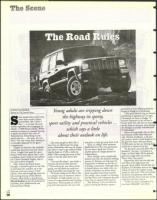
ground. Sport utility vehicles like the
Explorer or Cherokee seem to be th
wheels of choice for today's young
people on the move. The cars provide
the power and- presence that make
drivers feel like they're not just on the
road, but that they own it.
"I'd love to have a Cherokee if it
was more affordable" says Bryce