

Truce
Exclusive Report: A deadline looms, but there's
progress in the religious pluralism battle.
Seekers
ERIC SILVER
Israel Correspondent
wo members of the Israeli
commission seeking to sal-
vage Jewish unity from the
wreckage of the controver-
sial conversion bill were invited in
early December to a militantly secular
Hashomer Hatzair kibbutz. It was not
the first appearance by the two rabbis,
the ultra-Orthodox jurist Simcha
Miron and the Conservative lobbyist
Ehud Bandel, before a common audi-
ence. But this time it was different.
"Previously," Bandel explains, "we
met in broadcasting studios, but we
never exchanged a word. At Kibbutz
Beit Guvrin we were there as friends.
For the first time, Rabbi Miron real-
ized that it was we, the religious,
against them, the secularists."
The commission, chaired by
Finance Minister Ya'acov Ne'eman,
has radically changed the way
Orthodox, Conservative and Reform
leaders in Israel address one another
— in private if not always in public.
The mere fact that seven rabbis (five
Orthodox plus one each from the
Reform and Conservative movements)
are sitting down and negotiating is a
revolution.
They have surprised themselves by
the progress they have made towards
an agreed standard for conversion,
marriage and divorce.
Extensive interviews with represen-
tatives of all three denominations and
the government's official spokesmen
suggest, however, that they are not
there yet. Old suspicions do not die
overnight. Nor do vested interests and
T
1/9
1998
56
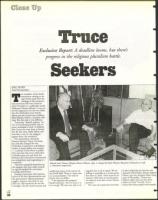
Miracle man? Finance Minister Yaacov Ne'eman, right, is charged by Prime Minister Binyamin Netanyahu to craft
a "conversion compromise."
conflicting visions of the essence of
the Jewish faith. There is a truce, but
not a reconciliation. The walls of
Jericho have not fallen.
"I do appreciate the progress,"
Bandel concedes, "but I'm sorry, it is
not enough. We want not only to sit
together, but to sit as equals. We are
willing to surrender to a certain point,
but there is a limit. There must be rec-
iprocity. Until now, no one has given
us reason to trust that we have honest
partners."
The cause of compromise has hard-
ly been helped by an interview the
Sephardi Chief Rabbi, Eliyahu Bakshi-
Doron, gave the Jerusalem Report mag-
azine in November. "If there are
Reform rabbis who say they don't
believe in God," he said, "isn't it
absurd that these people head temples