

and lead prayers? As rabbis, they're
clowns."
Ne'eman, an Orthodox Jew general-
ly respected for his moderating role in
the talks, compounded the damage by
lashing out at an American Reform
ketubah (marriage contract) from the
wedding of a couple who were not
only of the same sex, but were of dif-
erent religions.
"These and other recent comments
are both distorting the reality of
Reform Judaism in America and are
totally out of place with regard to
Reform Judaism in Israel," protests
Uri Regev, the Reform negotiator.
LAST SUMMER, JEWS IN ISRAEL
and the diaspora looked over the abyss
and were appalled by what they saw.
Without appreciating the wider reper-
cussions, the three Orthodox religious
parties in Prime Minister Binyamin
Netanyahu's coalition had presented a
bill which would have rooted in law
the de facto Orthodox monopoly on
conversions in Israel. It was
denounced by the Conservative and
Reform communities — a tiny minor-
fty in Israel, but a majority among
Jews in North America — as a decla-
ration of war, a death blow to any
hope of religious pluralism in the
Jewish state.
Israelis should not have been sur-
prised by the explosion. This was not
the first such confrontation between
Israel and the diaspora. For most
Israelis, the problem didn't impinge.
eform Judaism was an alien implant
that might be all right in godless
America, but didn't belong in the
Promised Land.
Eventually, reluctantly, they got the
message. "The issue of pluralism does-
n't speak to this government," admits
Bobby Brown, the prime minister's
American-born adviser on diaspora
lffairs, "the issue of Jewish unity does.
The specter of Jews turning their
backs on other Jews is one that haunts
this government."
So Ne'eman, an avuncular
Orthodox Jewish lawyer with a devi-
ous reputation for solving problems,
was appointed to head a joint com-
mission to seek a compromise that
would end the Reform and
onservative movements' legal chal-
lenges, which seemed likely to suc-
ceed, and to subsequently yank the
proposed legislation, which also
seemed likely to pass.
Over the past six months, the corn-
mission has met more than 50 times.
It is due to report by Jan. 31. Asked
what the chances for an agreement
are, the Conservative Bandel speaks
for most of the negotiators, choosing
his words with talmudic care: "I'm not
optimistic, but I'm hopeful."
The commissioners are spurred by
recognition that the Ne'eman
Commission is a unique, and probably
unrepeatable, opportunity. "There is a
deep awareness among the various
constituents of the Orthodox commu-
nity that we are at a crossroads in his-
tory," says the Orthodox yeshiva head
Nachum Rabinovitch, "and that unless
we reach some kind of accommoda-
tion, there is a real threat of the split
becoming a permanent schism."
For their part, the progressive move-
ments have lowered their sights. They
are no longer demanding unqualified
recognition in Israel. "We are willing
to go a long way in accommodating
the Orthodox in the interest of greater
unity, cooperation and respect," says
Regev, a sabra lawyer-rabbi who has
led the Reform's courtroom battles for
legitimacy.
Behind the willingness to compro-
mise there is also the knowledge that
most of the 200,000 Russian immi-
grants who have Jewish relatives, but
are not Jewish, are not interested in an
Orthodox conversion. They might
want to belong to the Jewish people,
but not on the restrictive terms
Orthodoxy offers. Government offi-
cials in particular hope that a
Conservative or Reform option might
draw them into the fold.
But a new issue, which has surfaced
Group Pushes Rabbis
Into Dialogue
DEBRA NUSSBAUM COHEN
Special to The Jewish News
group of prominent
Orthodox, Conservative
and Reform Jews ha.s
issued a public appeal
encouraging the work of a commit-
tee in Israel charged with resolving
the seemingly intractable conflict
over religious pluralism.
The group of 18 rabbis, acade-
mics and lay leaders was brought
together by Shvil HaZahav, an orga-
nization founded by modern
Orthodox Rabbi Shmuel Goldin, of
Englewood, N.J.
Goldin's work initially focused on
promoting pro-peace process atti-
tudes in the Orthodox community.
—
H e starte int
, t erdenomina-
he i
.
tional group last Jantiary, , when fric-
tion between liberal and Orthodox
Jews in the. United States began to
explode amid the push for Israeli
legislation to Codify. Orthodox con-
trol over conversions in Israel.
Participants in the dialogue
groupi which has been meeting qui
etly every several weeks, are affiliat-
with the centrist Orthodox-run
rvative
'versi
A
movement's Jewish Th.eological
Seminary and the Reform move-
ment's Hebrew Union College-
Jewish Institute of Religion, related
denominational organizations and
individual congregations.
They are urging that their model
of interdenominational trialogue be
replicated in other communities.
"There are some other communi
ties that have contacted us, but their
attempts are still pending," said
Goldin, whose group means "golden
path" in Hebrew. "By going public
and attempting to say that this is
working for us, we hope to encour-
age it in other places.
According to participant Rabbi
Eric Yoffie, president of the Reform
movement's Union of American
Hebrew Congregations, "American
Jews must move beyond their differ-
ences and engage their brothers and
sisters in civil dialogue. Only then
will we begin to develop a genuine
understanding of each other."
Another participant, Anne
Lapidus Lerner, vice chancellor at
JTS, said, "Our trialogue has
demonstrated that American Jews
cart,engage in civil discussion with
y.,e different — fre-
Mentally different --
oints of view. To achieve
derstanding, there must
ations all over the United
as we established here.'
nssbatun Cohen writes
Telegraphic Agency
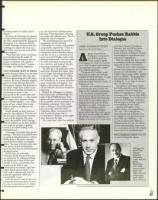
Talking u
Israel Prime
Minister
Binyamin
Aretanyahu,
center, met last
fall in
Washington,
D.C, with
Reform leader
Rabbi Eric
Yoffie, left, and
Conservative
leader Rabbi
Isrnar Schorsch.
1/9
1998
57