

eTNLiving0
Nutritional Battle Plan
•
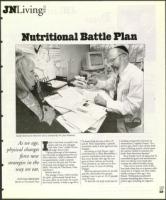
Sandy Rasmussen's bone-loss scan is reviewed by Dr. Jesse Krakauer.
'-
As we age,
physical changes
• force new
strategies in the
way we eat.
RUTHAN BRODSKY
Special to The Jewish News
I
took a hard look at myself in the
mirror and was very unhappy
with what I saw," recalls 73-year-
old Judge Avern Cohn.
"Taking advantage of the moment,
my wife made an appointment -for me
with a dietician. I paid in advance for
six appointments, made a commit-
ment, and over the past year I've lost
30 pounds and changed my eating
habits. Not only do I feel better, I also
look better."
Mirrors don't lie.
The passage of time, which enriches
the spirit, unfortunately doesn't have
the same effect on the body. No matter
how much exercise, a body at age 60 or
70 doesn't look the way it did at 25
and 35. More importantly, a person's
nutritional needs at these ages have also
changed.
According to Gail Posner, regis-
tered dietician in West Bloomfield, a
person's metabolism slows down so
that every decade after age 30, two
percent fewer calories are burned.
That slowdown can add two to five
pounds every 10 years if nothing
changes.
With less physical activity in the 40s
and 50s, add another five pounds,
making it easy to put on 10-15 pounds
every 10 years.
"In later life, the body works less on
building and growth and more on
maintenance," explains Posner. As a
person ages, there's a loss of lean body
mass, including muscle, which means
the calories needed to maintain the
body's basic functions decrease."
Even though much of aging may be
controlled by genes and environment,
there are choices to be made that
increase the odds of healthy living.
"One way to recover some of this
lean body tissue loss or to prevent addi-
tional loss is to figure out what makes
healthy eating at what age," says
Posner. "It becomes complicated
because everything slows down as a
person ages, including the digestive
12/26
1997
L9