

O
Iran
Shift
Prompts
Caution
JAMES D. BESSER
Washington Correspondent
I
s the Clinton administration
getting set to change course on
Iran? With a barrage of trial
balloons aloft, Jewish leaders
and Israeli officials, who have been
the strongest advocates of isolating
the Teheran government, were taking
the threat seriously.
Publicly, administration officials
insist that while they are eager to
explore possible new openings sug-
gested by President Mohammad
Khatami's conciliatory statements,
their conditions for improving rela-
tions remain unchanged.
But many Jewish leaders see hints
of a softening in the tough U.S.
position on economic sanctions —
although not the cave-in that right-
wing critics have predicted for
months.
"The line inside the administra-
tion is that some concessions on
sanctions may be necessary to avert a
confrontation with the Europeans,
and that this has nothing to do with
their concerns about Iranian missiles
and non-conventional weapons," said
a leading pro-Israel activist here. "We
see that as a dangerous and incorrect
distinction; any loosening of sanc-
tions would be perceived as a shift in
overall U.S. policy and a weakening
of our resolve."
Mr. Khatami called for dialogue
with the American people "in the
not-too-distant future."
President Clinton
responded cautious-
ly, saying he "wel-
comed" Mr.
Khatami's com-
ments. "I would like
nothing better than
to have a dialogue
with Iran, as long as
we can have an hon-
est discussion of all
the relevant issues."
The key words,
administration offi-
cials stressed, were
"all issues."
"From our per-
spective, it is not
new that we have
favored a serious dialogue between
the United States and Iran, as long as
all the issues are on the table," State
technology to Iran, are wor-
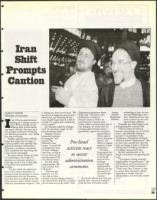
Ira nian
Department spokesman James
Pre sident
ried that Washington may
Foley said. "Of course, we're
Mo hammed
use a softening of Iran sanc-
looking for a change in
Kh atami.
tions to shore up the erod-
Iranian actions as well as an
ing anti-Iraq coalition.
improvement in Iranian state-
Generally, pro-Israel leaders were
ments. And as we have often said, in
downplaying the rumored shift.
any dialogue, we would raise our
"There's reason for concern
concerns about Iranian actions —
because we're seeing a lot of trial bal-
specifically, support for terrorism,
loons," said Malcolm Hoenlein,
sponsorship of
executive vice president of the
violent opposi-
Conference of Presidents of Major
tion to the peace
American Jewish Organizations. "But
process, and
we have been assured that there has
efforts to acquire
been no change in policy; all they're
weapons of mass
talking about is looking carefully at
destruction."
the signals coming from Iran."
The State
But the undercurrents in the
Department flat-
Jewish community were growing this
ly denied reports
week.
in the Israeli
"The debate is being seriously
press of secret
waged within the government," said
meetings
David Harris, executive director of
between high
the American Jewish Committee.
administration
"That's very clear. If there is a way
officials and rep-
to retreat from sanctions without
resentatives of
appearing to retreat, then the
the Iranian gov-
administration will seriously consid-
ernment.
er it."
But Israeli officials and their sup-
porters here, concerned primarily
with the flow of Russian missile
Pro- Israel
activi sts react
to recent
administration
comments.
12/26
1997
29