

U.S.
Pressure Off
Netanyahu,
For Now
JAMES D. BESSER
Washington Correspondent
fter weeks of escalating
criticism, the Clinton
administration has sudden-
ly taken a more benign
tack in its dealings with Israeli Prime
Minister Binyamin Netanyahu.
But with tensions in the region
mounting over Mr. Netanyahu's
recent comments calling the West
Bank part of "Israel proper," it is not
clear how long the amicable mood
will last.
Last week, administration officials
signaled publicly and privately that
they now believe Mr. Netanyahu is
committed to the peace process, and
that they are ready to give him an extra
month to deal with his divided cabinet.
In a call with leaders of the Con-
ference of Presidents of Major Amer-
ican Jewish Organizations, Secretary
of State Madeleine Albright — who
had signaled a few weeks earlier that
her patience was wearing thin — was
surprisingly upbeat about her meet-
ing with Mr. Netanyahu in Paris,
despite the fact that the Israeli Cabi-
net was still wrangling over compet-
ing plans for the next West Bank
redeployment.
She said she now
believes both Mr.
Netanyahu and
Palestinian leader
Yassir Arafat are
"honorably engaged"
in the peace process,
despite the big gaps
between them.
She also revealed
a much tougher line
with the Palestinians
on security.
"She related to us
that she told Arafat
that he has to devel-
op a systematic
approach [to securi-
ty] that has to be
comprehensive and
fully implemented,
or he can forget
about the further
redeployments," said
Malcolm Hoenlein,
executive vice chair
of the Conference of
Presidents.
She told the Jew-
ish activists that her
meetings last week
produced
a "road
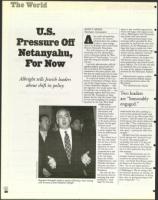
Binyamin Netanyahu speaks to reporters following a Paris meeting
map"
for
the
next
with Secretary of State Madeleine Albright.
Albright tells Jewish leaders
about shift in policy.
12/26
1997
28
phase in the troubled negotiations, •
which will begin with separate sum-
mits in Washington with Netanyahu
and Arafat early next month.
The administration hopes those
meetings will be preceded by firm
proposals by Israel for the next rede-
ployment. At the Washington meet-
ings, they hope to work out a fast-
track timetable for final-smalls nego-
tiations and an informal "timeout"
in the expansion of settlements.
At those sessions, the leaders also
will discuss a joint security docu-
ment prepared by the Central Intelli-
gence Agency. The CIA also will play
an enhanced role as an umpire on
the issue of the release of suspected
terrorists by the Palestinian Authori-
ty.
Administration sources confirm
that the mood has shifted, despite
the escalating rhetoric about the
West Bank.
"The administration clearly
Two leaders
are "honorably
engaged."
understands that their pushing in
recent weeks produced results, and
now it's time to lay off and give Bibi
a chance," said the leader of a major
Jewish group who closely follows the
peace talks. "They understand very
clearly the dangers of backlash, and
they haven't lost track of their pri-
mary goal — getting the talks start-
ed again."
Albright heard the message from
Jewish groups that "pressure to get
the peace talks going might be
acceptable, but only if it's fair and
balanced," this source said. "The
intensified pressure on the Palestini-
ans is a clear indication they heard
that message."
"The administration sees its
strategic interests inextricably con-
nected to the Israeli-Palestinian
track," said Mark Rosenblum, politi-
cal director of Americans for Peace
Now. "So we can expect positive,
continuous intervention on the part
of Washington. We are seeing a fair
and balanced position on the part of
the Clinton administration; in doing
that, they are giving meaning to the
term 'reciprocity.' "
❑