
aesthetics of buildings. With his stu-
dents, he did research and took on
projects.
"My first book, Color Model Envi-
ronments: Color and Light in Three
Dimensional Design, was published in
1985," Linton reported.
Later books concentrated on the
pole of color in architectural illustra-
tion, architectural sketching, concept
sketching, forecasting and portfolio
design.
His next book, due out in 1999
or 2000, will be titled Color in
Architecture: Design Methods for
Buildings, Interiors and Urban Spaces.
Simultaneously, he will co-author
a book with European colorist Jean-
Philippe Lenclos, who was asked to
do the color design for the interna-
tional airport at Seoul, Korea.
"We will present Lenclos' approach
to work on products, architecture,
industrial design, forecasting and fine
arts," revealed Linton, who spent the
1996-97 school year on sabbatical
from LTU to set up a master's degree
program in color studies at the Uni-
versity of Art and Design (UTAH) in
Helsinki, Finland.
"I was invited to set up the pro-
gram in Finland based on my work,
publications and a lecture at the First
International Conference on Color
Education," said Linton, still an advi-
sory board member for the innovative
program.
While in Helsinki, he took on
other projects — a wall relief for the
U.S. embassy, a Color Archive Col-
lection for the UTAH and color plan-
ning for an apartment complex, an
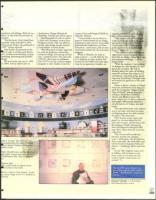
Abov e: Linton's "Star of David" was
commissioned for the celling -ofr,*:. ,
‘1-11,raels Hodari Children's Librarian.
I Media Center.
8
Right: Harold Linton andhi4-2.4t,:.: .
pose before a recent series of works titled:
I"Midsummer's Eve," done in °°unlecol
on-.
Opposite page:
jTop.. Linton works on shaped canvas
'-tc)nstructions in his studio.
Bottom: Linton's "Four Seasons," acrylic
on canvas, hangs in the U.S. Embassy in
Finland.
ongoing coniitittMerit. that
student participatOri.
The archive collection _in
original art design objet
fessionali-thratigho
-:'
Linton explained,: "There,-''
works donated by 37 pro
from 17 thuntries.
The calle6tion gives stai*:40
opportunity to view original:
from fine art design, industria jdesign
and architectural design --- all -the-
design fields.
"With the students, I am working
on designs for color facades of a new
apartment complex. We will be
thinking about the color of building
materials and how they relate to the
architecture, including design details
and street furnishings. Through color,
we'll realize the potential of the archi-
tecture."
Closer to home, visitors to Temple
Israel can understand more about his
work by viewing his "Magen David
(Star of David)" placed along the
ceiling at the Hodari Children's
Library and Media Center. The
piece, which runs 14 feet in diameter
and weighs 300 pounds, features a
colorful pattern of stripes, arcs and
bands.
"The idea behind the color scheme
was to use color with form to create
overlapping planes that help animate
the space," the artist said.
Other Linton works, often com-
pleted on canvases shaped by his
wife, also an artist, can be seen at the
Birmingham Temple (Humanistic
Arcs) and Beaumont Hospital (Wel-
come Arcs). Many more are in private
collections.
"The current color trends are
found in neutral, yet complex,
tones," said Linton, who pointed out
that, at any time, the same color style
will be found in disparate fields and
objects — buildings, fabrics and even
cars.
"In the '80s, brighter colors were
in fashion, and we expect to see
those return as we enter the 21st
century. Color trends always are
cyclical." ❑
On our JIVE cover, Harold Lin-
ton in front of one of his earlier
works, "Red Rooster," acrylic on
canvas.
Suzanne Chessler is a Farmington
Hills-based freelance writer.
12/19
1997
123
Scanned image of the page. Keyboard directions: use + to zoom in, - to zoom out, arrow keys to pan inside the viewer.
December 19, 1997 - Image 123
- Resource type:
- Text
- Publication:
- The Detroit Jewish News, 1997-12-19
Disclaimer: Computer generated plain text may have errors. Read more about this.