

•
ADAM MARCUS
Special to The Jewish News
CI
n a wintry night in early
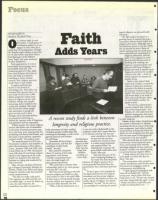
November, a small group of
worshippers gathers at a syn-
agogue in Ann Arbor for a
quick dose of evening prayer. Though
the Tuesday night minyan is two short
of 10, that doesn't stop them from a
brief discussion of the Hebrew
letter "kaph" and some moments
of silent meditation.
From appearances, it is not a
particularly devout group, nor a
particularly strict one. Two
women are part of it. But, aside
from their Judaism, they have at
least one thing in common:
according to newly released
research, their religious practices
could improve their health.
In papers published last
-
month in the Journal of
Gerontology, Drs. Ellen Idler and
Stanislav Kasl reported that a 12-
year study of more than 2,800
elderly people has linked atten-
dance at religious services with
healthier old age and, equally
interesting, better health for the
moderately disabled. The study
also found that elderly people
who participate in group reli-
gious services tend to have
stronger social networks and bet-
ter emotional well-being, as
defined by a greater sense of happiness
and optimism and less depression.
"Elderly people who attend religious
services take better care of themselves
in the sense of several preventive prac-
tices, they have more opportunities for
socializing with family and friends, and
they have a more positive, optimistic
outlook on life," the authors wrote.
The study focused on 2,812 Jews,
Protestants, Catholics and members of
other denominations in New Haven,
Conn., between 1982 and 1989, with
a final follow-up in 1994. Participants
were older than 65 and living indepen-
dently at the beginning of the study,
which was funded by the National
Institute on Aging and conducted by
Yale University.
Idler, associate professor of sociolo-
gy at Rutgers University's Institute for
Health, Health Care Policy and Aging
Research, said the study was extraordi-
narily comprehensive.
"The data are really, really good.
The response rates (82 percent) were
incredibly high," as were the follow-up
rates, she said. Moreover, the
researchers were able to control for a
12/12
1997
76
logical influence on physical health
outcomes."
The Yale study is the latest in a
growing litany of research showing a
connection between better health and
religious observance. Although such a
link had been drawn in the late 1890s,
the last decade has seen a flurry of
reports claiming that the social struc-
tures established and maintained by
religious observance, and the
habit of the religious to avoid
- A s
detrimental behaviors such as
drinking and smoking, can
improve a person's psychic and
§physical well-being. Religious
people also tend to exercise more
frequently and limit the number
of lovers they take — both of
•
which improve the chances of
healthy living.
Back at Ann Arbor's Beth
Israel, Jerry Schafer, a retired dis-
tributor of pharmacy products,
pointed to his father as anecdo-
tal evidence of piety's impact on
health. The soon-to-be 94-year-
old davens daily at his shuls in
Flint and south Florida, where
he and Schafer's mother, 91,
spend winters.
"He just has a phenomenal
positive outlook that I think is
part of his being Jewish," said
Schafer, 67, who added that his
parents' strong genes and active
lifestyle probably also contribute
to their longevity.
Schafer, of Ann Arbor, himself spent
the month of November in shloshim,
mourning the loss to cancer of his long-
time companion. And while he didn't
it was not cool or fashionable in the
wide assortment of other variables,
attend services as frequently before her
academic world. But it seems like late-
including peoples' health habits like
death, he now recognizes that they gave
ly it's become very big. My own per-
smoking and drinking, as well as their
him the same sense of belonging and
sonal conviction is that this is
general physical and emotion-
community in his time of grief
al well-being.
Ed Schteingart an area that has not been
Idler admitted that the study leaves
"Attendees did have better
and other wor- studied very much but there
unanswered
several important ques-
shippers at Beth is a really strong theoretical
health practices, and that did
tions,
chief
among
them whether
•
and empirical basis" for
Israel in Ann
contribute to their better •
attending
religious
services
could
pro-
Arbor may live thinking that a person's reli-
health," she said.
long life. Another was whether going
gious beliefs could affect their
longer and
Idler said Jews comprised
to services had any negative effects.
healthier,
health,
Idler
said.
about 15 percent of the study
"I think that's a live issue, but we
according to a
Kasl said that one of the
population, with Roman
can't
speak to it from the data we
recent study.
more intriguing findings of
Catholics comprising 50 per-
have,"
she said.
the study was that the public
cent, the single largest reli-
One
young man, who wanted to
element of religion seems to be a
gious group represented.
remain
anonymous,
said that for some,
more powerful beneficial force for
"We could look at whether these
the
stresses
of
synagogue
could be
good health than individual spiritual-
relationships held in the other groups,
unfortunately
overwhelming.
ity.
and they did," she said.
"I think [going to synagogue] took
"To me, I guess I am surprised by
Idler first started looking at the link
years
off my father's life," said the
the distinction between the religious
between religion and health as a doc-
young
man, whose father died from
attendance and the private religious-
toral student at Yale in the mid-1980s.
lung
cancer
at 62. "He got very stressed
ness, and that the benefits are from the
In those years, viewing health through
out
when
things
didn't go right" at shul.
public aspects of religion, the church
the lens of faith was unpopular, at best,
"Maybe
attendance
is good for your
attendance," he said. "To me, this is a
and more likely shunned, she said.
health,
but
shul
politics
isn't." ❑
nice paradigm for studying the psycho-
"When I did my dissertation on it,
Adds Tears
A recent study finds a link between
longevity and religious practice.