

feminist movement really devalued
family. What used to make me
uncomfortable is that they seemed to
want to make women into female
forms of men, and they didn't seem
to understand there were differences,"
she said.
Orthodoxy conveys the kind of
spirituality and principles that many
women believe, including Goldfein.
"I understand that things have to
change slowly and you can't throw
the baby out with the bath water.
Women have to be in the forefront of
change within the Orthodox move-
ment."
Greenberg believes it's a matter of
time before women are ordained as
Orthodox rabbis.
"I don't think it's as radical a
thought as either it seemed 10 years
ago to me or as it seems in the com-
munity, given the great numbers of
learned and learning women," she
said. "I think some things will take
longer than others. For example,
women in pulpit positions — I don't
foresee that in the next decade or
two. But I do see women with the
title of rabbi as teachers, as some-
thing more immediate." El
ried women to do so. But it's an issue
that can make women feel hidden
away.
"From the studying I've done, I
jhink it's open to a lot of interpreta-
tion, and it's obviously a very person-
al decision," said Goldfein, of
Southfield. Greenberg does not cover
her hair, nor do a handful of other
Orthodox feminists around the coun-
try.
"When I got married and my
female classmates [from Toronto's
Community. Hebrew Academy]
rot married, none of us covered
our hair," Goldfein recalled. "I'm
the only one who remains not cover-
ing my hair. It is both a religious
decision as well as a cultural deci-
sion." To be a modern Orthodox
woman today sometimes means
doing things like covering your hair
when you may not truly want to,
simply because it is the accepted way,
•he adds.
Greenberg said that Torah is both
eternal and contextual. Goldfein
agreed.
"In the context of the 20th centu-
ry, the culture in which I currently
live, I don't feel that the issue of
sneut necessarily means I must cover
my hair," Goldfein said. "I feel that
the issue of sneut is not equally dis-
Tributed. [Like the] issue of mikvah
— where women have to be clean
before they enter, but men can go
straight from their health club work-
ing out and jump in."
Part of the Jewish resistance to
feminist ideals, said Greenberg, is the
fear that "feminist ideology poses an
underlying threat to Jewish survival"
by women moving in a more secular
direction because they are dissatisfied
with their lack of access.
But there are several areas within
halachic Judaism where feminism can
be "applied creatively," like in family
law and religious courts, by leveling
the playing field in regards to Jewish
divorce; and in education, by allow-
ing girls, like boys, access to all of
Torah learning.
For Chana Finman of Oak Park,
the mother of six girls, providing a
good education to girls is essential,
but for different reasons.
"Keeping the family going, keep-
ing the culture going and perpetuat-
ing godliness is the greatest thing any
human being can do. That is true
feminism," said the rebbitzin, who
grew up in a family with strong femi-
nist leanings. "This is why I'm a
Lubavitcher. The chasidic view his-
torically was not appreciated in outer
circles, but the girls had to have a
good education. It's explained in a
tractate put together by the Alter
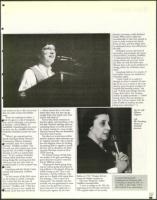
Top Far Left:
Nehama
Glogower
Le :
B u Greenberg:
Pioneer of
Orthodox
feminism.
Rebbe in 1776." Finman did not
attend the Skokie conference.
The term "feminism" makes
Goldfein uncomfortable.
"I went to college in the '60s, the
beginning of the feminist movement.
The original leaders of the secular
12/12
1997
69