
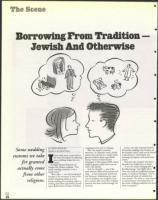

Borrowing From Tradition
Jewish And Otherwise
Some wedding
customs we take
for granted
actually come
from other
religions.
12/12
1997
70
ALLISON KAPLAN
Special to the Jewish News
I
f you really want to get back to
the roots of Judaism in planning
your wedding, forget the cere-
mony.
As Rabbi Dannel Schwartz of
Temple Shir Shalom explains, "The
whole wedding ceremony is not a
Jewish event."
That's right — even the breaking of
the glass is not necessary. It may be the
tension-shattering climax to every
Jewish wedding, but breaking a glass is
nothing more than superstition, accord-
ing to Rabbi Steven Denker of Reform
congregation Kol Ami in Chicago.
Also, the tuxedo is entirely
American. In Talmudic times, Jewish
grooms got married in a simple white
garment called a kittel, says Rabbi
Danny Nevins of Adat Shalom
Synagogue in Farmington Hills. Many
religious grooms today still wear the
white robe (kittel).
And the chuppah — one of the
more obvious marks of the Jewish wed-
ding — is not required by Jewish law,
says Schwartz. Symbolizing the open
tent of Abraham, the chuppah is sim-
ply a custom, like most other wedding
practices that have evolved though the
centuries.
In fact, the only required elements
of a Jewish wedding, says Denker, are
the ketubah (which need not be framed
or decorated in watercolors), the
exchange of property and sexual inter-
course.
Not quite the romantic trip down
the aisle most brides have in mind.
"I see two trends emerging that I
find fascinating," says Rabbi Stacie
Fine, who leads an unaffiliated congre-
gation in northern Michigan. "One is
to include all kinds of symbols that
aren't Jewish. The other is a real interest
in uncovering or recovering some of
the Jewish wedding traditions that have
been less popular."