

O
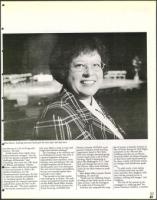
Shira Breuer: Teaching observant Israeli girls the same topics that boys learn.
just the way it is. So it's living with
tension," she said.
Jewish society, from which many
famous feminists emerged, "was one
of the last groups to grapple with the
challenges of feminism," said
Greenberg, who wrote the 1981 book
On Women and Judaism. Neither
(Reform, which called for full equality
of men and women in 1846 at the
Breslau Conference, nor the
Reconstructionist movement, the first
to allow bat mitzvahs and female aliy-
ot, "accepted women for rabbinic
training until the women's movement
pushed them across the line" in the
1970s, she said. "The more tradition-
al the Jewish community has been ...
the more likely it tends to resist chal-
lenges from feminist ideology."
For Greenberg, to be a feminist and
an Orthodox Jew means "that there is
a greater integration and greater
responsibility, more expression, more
learning, more participatory roles. All
outright inequities and all forms of
discrimination have to be eliminated.
You can't rewrite history and tradition,
but you can certainly bracket them
and make a new reality." .
That seemed to be what women
were looking for in Skokie. The audi-
torium was packed for keynote speak-
ers like Rabbi Dovid Silber, founder
and dean of the Drisha Institute for
Jewish Learning, and Rabbi Saul
Berman, founder of EDAH, a pro-
gressive Orthodox Jewish learning
organization based in New York.
Both men strongly advocated giving
women equal access to all of Torah
learning, which is happening in
places like Washington, D.C., New
York and Chicago but not in cities
like Detroit, where most Orthodox
circles do not allow women to study •
Talmud.
After Rabbi Silber's speech,. Rachel
Goldberg, 28, stood up.
"Thank you for validating instead
of telling us how lucky we are to have
what we have," said the Chicagoan.
"I'm really sick of hearing that."
And then she compared the strug-
gle of women in halachic Judaism to
that of blacks during the Civil Rights
movement in the '50s and '60s.
Goldberg said that just as African-
Americans didn't see things changing
in their favor until whites stood up
for them, neither will Jewish women
see changes until Jewish men speak
out.
"I'm glad you're a man saying
this, because until men say they
won't stand for their daughter, wife,
sister having unequal access to
Judaism, nothing will change," said
Goldberg.
"The role of the woman in, the
synagogue is a really big deal" for
Janice Starkman Goldfein, a member
12/12
1997
67