

F eminism
compatible
Are they
Orthodoxy
?
LYNNE MEREDITH COHN Staff Writer
Photographer DANIEL LIPPITT •
S
or most of her life,
Blu Greenberg has
davened in Orthodox
synagogues where the
mechitzah (partition
separating men and
women) cut straight down the middle
of the sanctuary. She rarely strains to
hear the chazzan chanting or to see
the bimah.
And that, says one of the most
vociferous and respected Orthodox
feminists in this country, is the way
gender should be treated in Judaism:
distinctive and equal. Not separate
and equal, but distinctively male and
female within the confines of
Halachah (Jewish law).
"Halachah has conditioned my
psyche, not just the act, but also
affected my deep inner areas of com-
fort," Greenberg said. "As far as the
mechitzah goes, I don't feel a depriva-
tion sitting in the women's side. The
mechitzah has to be constructed so it
[encompasses that] notion of distinc-
tive and equal, not distinctive and
second class."
At first glance, the concepts of
feminism and Orthodox Judaism
seem not only incompatible, but
downright contradictory.
Orthodox Judaism calls men to
the Torah for aliyot, celebrates the
bar mitzvah of a 13-year-old boy,
allows men to sing in public and
dress however they want to dress.
1111
12/12
1997
66
Women, on the other hand, are for-
bidden to sing in public and must
cover their knees and elbows at all
times.
So, can feminism co-exist with
Judaism? Many women think it's a
matter of time.
For the past 30 years, the notion
of Orthodox feminism has grown in
popularity. In Riverdale, N.Y., and
Skokie, Ill., women's tefillah (prayer)
groups thrive; they provide a public
forum for women to pray together,
read from the Torah on the bimah
and celebrate bat mitzvahs of 12-
year-old girls. In congregations from
Potomac, Md., to Los Angeles,
women dance with the Torah on
Simchat Torah.
At a conference on women,
Halachah and modernity last month
at which Greenberg was a keynote
speaker, hundreds of women came
together, some from as far away as
Jerusalem, to voice their hopes and to
listen to others who are changing the
role of women in Orthodox Judaism.
The conference, held in Skokie, was
an offshoot of a New York gathering
last February on feminism and
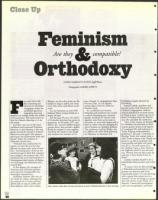
Four women, three hats: An issue of concern to some Orthodox feminists is hair covering.
Orthodoxy, largely planned by
Greenberg.
Susann Codish, president and
founder of the Oak Park-based Or
Chadash Congregation, believes
women should have as much access
to Torah as men. Codish was one of
about 15 women from the Detroit
area who attended the conference.
"One of the reasons we founded
Or Chadash was precisely to allow
women greater access to all aspects
of synagogue life and inclusion in
Torah, keeping within halachic
guidelines," she said. "Certainly on
Simchat Torah, the women took a
sifrei Torah to dance with. People are
going to say this is improper and
unacceptable and blast the institu-
lb
tion for it, I'm well aware of it.
On Shabbat I give a d'var Torah on
the Haftorah, and I'm not the only
one. Women here are free to get up
and give a d'var Torah if they so
desire."
Codish considers herself to be a
halachically-observant Jew and a fem-
inist.
"It means I live my life accordini,
to Halachah and sometimes I corn-
promise my feminist side to be
halachically proper. I'm not davening
with a group that counts me in a
minyan; I'm not davening in a group
that will call me to the Torah. As a
feminist, I desire full participation
and I am not getting it, and that's