
0
town. That means hanging out at pop-
ular Hollywood restaurants like The
Grill, Kate Mantilini's, Spago and Far-
falle, and catching the buzz about new
pictures and who is attached to them.
"If I hear that Arnold Schwarzeneg-
ger is about to do a picture for Warner
Bros., if no one else has heard about it,
then that's really good news for me to
report," Cox says.
"I may call a production executive at
Warner Bros. and verify the informa-
tion. If he doesn't know, I'll call the vice
president and keep going up the ladder
until I find the information I want. Or
I might call Schwarzenegger's agent."
Cox says the studios typically deny
that a deal is done. They don't want the
information released before a contract
is signed, fearing that an actor may
drop out.
The Story Spreads
"This is the highest-paid woman in
Hollywood," says Brown, "yet the audi-
ence is turned off by the way she han-
dles her celebrity and by the movies
(Striptease and The Scarlet Letter) she's
done that have not done well."
Brown spent several days making
calls to people associated with the film
to see if in fact Moore's movie might be
a bomb, or at least a difficult sell. Her
list included "the production company,
agents, managers and people who have
firsthand knowledge, and I got nothing
but confirmation," she says.
Brown also discovered data from the
National Research Group, a Los Ange-
les-based concern that obtains hard
numbers for Hollywood studios by
measuring an audience's interest in a
concept and in a star.
"The research [on G.I. Jane] showed
the audience was not at all interested in
seeing Demi Moore. So I ran [the
story]," says Brown.
"It had a huge reaction and was
picked up everywhere because it was
empirical evidence about this person
we've all felt ambivalence about as a
star. She certainly sells magazines, we
certainly want to read about her, but
we haven't been going to her movies."
In many cases, newspapers and maga-
zines are setting the agenda for televi-
sion news shows and programming,
says Bernie Weinraub.
Consider the release of Paramount
Pictures' In and Out, starring Kevin
Kline and Tom Selleck, whom Wein-
raub interviewed when he
thought he'd found an interesting
angle.
"I did a story that was pegged
to the film. It was a story about
how actors now are increasingly
happy to play gay roles. Ten, 15
years ago, they didn't want to do
that because they thought it
would hurt their careers:
"In & Out was an interesting
story," says Weinraub. "It said
something about Hollywood, it
said something about changing
times in Hollywood, and that
sort of story is accessible to peo-
ple who read the paper.
"It's news like this that might
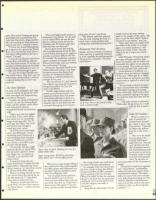
spark an idea for an Oprah Win- Above: Men In Black: Breaking the story of a
billion-dollar baby.
frey show, for a spoof on 'Satur-
day Night Live,' an episode on
Right: Going public: We like to read about
(Seinfeld' or an interview with
Demi Moore, but is she box-office poison?
Katie Couric."
A reporter's stories also can
create controversy. Consider the half-
Why were so many people willing to
page article in Newsweek that Corie
share information that could jeopardize
Brown wrote on G.I. Jane three months
box office grosses and Hollywood rela-
in advance of the film's release.
tionships? And how did Brown know
Brown was doing research on sum-
they were telling the truth?
mer movies when she learned the stu-
"You ask people honest questions
dio that produced G.I. Jane didn't
because people want to be honest.
know how to market the film.
Then you never believe them, and you
"Audience research says this is a
just check what they say. People have a
good movie, but they don't want to
desire to have their point of view out
see Demi Moore," a studio executive
there, and they usually honestly believe
told Brown.
their point of view," says Brown.
"That doesn't make their point of
view the truth. Finding the truth is a
much more complex problem than
writing what somebody honestly feels."
Exclusivity And Accuracy
Another element involved in entertain-
ment reporting is exclusivit5r. Exclusivi-
ty is key, especially for publications like
Variety and its competitor, The Holly-
wood Reporter.
In & Out: The ins and outs of a story
with a national angle.
volatile and ran tbe story anyway,
much to the chagrin of the studio. "My
job is to get the news which I think is
of interest to our readers," says Cox.
"Quite often that is in conflict with
the wishes of the studio, or a certain
agent, or a certain producer. I can't
respect all of their wishes. The only
thing I can do is respect my editor's
wishes."
Adds Weinraub, "Sometimes people
get angry and upset and they don't
return your phone calls for awhile, but
eventually they realize it's not personal,
it's not animus. They realize you have a
job to lflo, and they have a job to do."
As for accuracy, it is difficult in a
business where everything is changing
all the time. "What goes on in Holly-
wood is based on perception and what
people want as opposed to what's real,"
says Cox.
"It's very hard to discern between
what's real and what isn't. Inevitably,
information is going to be wrong
some of the time. You'll write a story
about somebody signing to do a pro-
ject and then three days later he'll be
out of it.
"My only concern is exclusivity.
That's what Variety thrives on. I want
to be the first to report
I it."
o Code .0f Conduct -
But racing to press can wreak havoc
on issues of accuracy and etiquette.
For example, Dan Cox learned early
on from a source at Sony that Robert
Cooper, president of HBO, accepted a
job as president of Tri-Star Pictures.
When Cox called Tri-Star, the company
denied it. An hour later the rumor was
confirmed, but Cox was asked to wait
until the company was ready to
announce it.
Variety felt the information was too
When it comes to a ;
code of conduct for
entertainment journal- .t.
ists, "there is none," says
Corie Brown. "A journal-
ist reflects the publica-
tions he or she works
for."
"You try to do stories
that are going to be
truthful and honest,"
adds Dan Cox, "but you
can't sell short the fact
that newspapers have to
sell. Entertainment news
has become so pervasive.
Everyone wants to write
and read entertainment
news. So you have to
pick stories that will be of interest to
people."
"Newsweek is a hard-news organiza-
tion," notes Brown, "and therefore
reflects the hard-news aspects of the
entertainment industry. The trades
reflect the need of the town to know
every little thing that's going on. The
National Enquirer is for housewives
with no lives who need to read about
celebrities. They are all serving their
audience." El
12/1
199
87
Scanned image of the page. Keyboard directions: use + to zoom in, - to zoom out, arrow keys to pan inside the viewer.
December 12, 1997 - Image 147
- Resource type:
- Text
- Publication:
- The Detroit Jewish News, 1997-12-12
Disclaimer: Computer generated plain text may have errors. Read more about this.