
•INGifd
Eight Questions
In his new book, author Shimon Apisdorf answers the questions
people ask about Chanukah.
altimore author Shimon
Apisdorf wants Je*s to dis-
cover the soul in the flame of
Chanukah candles. His mis-
sion, he says, is to "peel away the
outer layers of Chanukah — the
wrapping paper — and reveal a pro-
foundly rich, spiritual core to the
holiday."
Mr. Apisdorf fulfills this goal in his
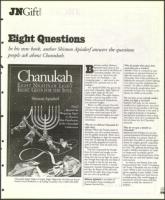
new book Chanukah: Eight Nights of
B
IGHT IGHTS
to Discover
New Thmensions
of the Chanukah
. Celebration
Chanukah Eight Nights of Light, Eight Nights for the Soul can be pur-
chased at local bookstores or by calling Leviathan Press 1 - 800-538 - 4284.
Light, Eight Nights for the Soul
(Leviathan Press). The eight chapters
provide a step-by-step guide to the
holiday with practical explanations
and spiritual insights.
Below, we offer excerpts from his
chapter on the eight questions people
ask about Chanukah. The excerpts
have been edited and some of Mr.
Apisdorf's personal insights are omit-
ted from the answers due to length
constraints.
Why do we celebrate Chanukah for
eight days?
Answer: When the Temple stood in
Jerusalem, one of its central elements
was the golden menorah. There was a
special obligation to light the menorah
every day. In lighting the menorah,
only specially prepared oil could be
used as the fuel. This oil took seven
days to prepare.
The Jews recaptured the Temple
from the Greeks and sought to rein-
state the daily activities. The first
thing they did was to light the meno-
rah, though they had only one flask of
oil, enough to last for just one day.
After the menorah was lit, a miracle
happened. Instead of burning for just
one day, the flames of the menorah
stayed lit for eight days, long enough
for new oil to be produced.
Shimon Apisdorf is an author of
several Judaica books including the
Passover Survival Kit.
..„
Why do people often place their
menorahs near a window?
Answer: There is a mitzvah (a com-
mandment or spiritual directive) to
light the menorah every night of
Chanukah. Part of the procedure for
lighting the menorah involves lighting
it in such a way that "publicizes the
miracle." In order to fulfill this aspect
of the mitzvah, people place their
menorahs in front of a window so the
flames are visible to the public.
Do you have to use colored candles
when you light a menorah?
Answer: Not only are the colored
candles not a requirement, you don't
even have to use candles at all if you
don't want to. Because it was used in
the original menorah in Jerusalem
and because it produces such a beau-
tiful flame, olive oil is considered the
fuel of choice for the Chanukah
menorah.
Why do we spin a dreidel on
Chanukah?
Answer:Jewish holidays are not just
commemorations of historical events.
Every holiday is a unique island of
spirituality that offers a special oppor-
tunity for insight, growth, inspiration
and a deepening of one's connection
to God. The spiritual furnishings that
create a holiday atmosphere are made
of things such as mitzvot, special
prayers, meals, selected portions of the
Torah that are read and studied, songs
and customs.
At times in our history., Jews were
imprisoned for the "crime" of studying
the Torah. Chanukah was one of those
times. While in jail, these Jews would
gather together to play dreidel. Under
the guise of idling away their time on
a simple game, they would engage in
discussions of Torah topics and thus
continue to defy the enemies of
Judaism.
Scanned image of the page. Keyboard directions: use + to zoom in, - to zoom out, arrow keys to pan inside the viewer.
December 12, 1997 - Image 129
- Resource type:
- Text
- Publication:
- The Detroit Jewish News, 1997-12-12
Disclaimer: Computer generated plain text may have errors. Read more about this.