
Business
to
Augsteik
.* - 60xii@kiectkx.
—
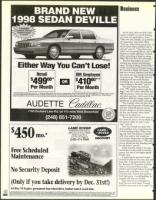
GM Employee
$41000 **
Per Month
*Total due at delivery $3,763 plus Luxury Tax. ** Total due at delivery $3,447 plus Luxury Tax & option papers. GM & NOn-GM employees both must qualify for owler loyalty incentive. Lease is
a 27 month closed end lease with approved credit. $1,000 down payment, acq. fee, 1st month payment, sec. dep., tax, use tax, luxury tax and plates. 12,000 miles per yr. 150 per mile over.
Leasee responsible for extra wear & tear, car may be purchased at end of lease for price determined at lease signing. Offer ends November 30, 1997.
7100 Orchard Lake Rd. (at 14 1h mile) West Bloomfield
(248) 851-7200
$450 mo.
LAN ,ROVER
FARMINGTON HILLS
Affiliated with Erhard BMW
38200 Grand River
Just East of Haggerty
(24 8)474-99 0 0
i‘ROVER
DISCOVERY
Free Scheduled
Maintenance
No Security Deposit
(Only if you take delivery by Dec. 31st!)
12/5
1997
152
4.0 liter, V8 Engine, permanent four-wheel drive, leather seats & wood trim
' Offered by participating Land Rover Retailers to qualified lessees in conjunction with Land Rover Financial Services (a unit of BMW financial Services NA, Inc.) Subject to credit approval. Monthly payment based on 33 month closed end lease for 1998 Discovery LE. MSRP
535,125 including destination charges. Cap cost.532,580. Total monthly lease payments 514.860.89. 52.995 down payment. Acquisition fee 5450. Lessee responsible for taxes, registration/title and license fees, maintenance, repairs, excess wear and tear, insurance and any
options plus an excess mileage charge of 15 cents per mile for each mile over 10.000 miles per year. Purchase option at maturity 523,533.75 applicable tax. 5250 termination fee if vehicle is not purchased. Lessee does not acquire ownership rights unless the purchase
option is exercised. 53,445 due at signing. Other conditions may apply. Equally competitive values available on all Discovery models. Retailer participation may affect cost. Must take retail delivery by December 31. 1997. Subject to availability. See Retailer for details.
At the time, there was little infor
mation available on ostrich farming,
and none was applicable to Israel.
There was also, initially, no possibility
of cooperation with South Africa.
"Later on, when things opened up, we
found South Africa couldn't help us
anyway," says Or. "They farm exten-
sively, not intensively like us, and con _
ditions are totally different. In South
Africa everything is based on cheap
labor. We don't have that advantage."
The first department set up by
Zemach was research and develop-
ment. To help it along, Israel's Office
of the Chief Scientist donated money
for research at Israeli universities. This
was not a success, however, and when
the money ran out, Zemach still had a
long way to go. "We hardly achieved
anything from this work because
everything was so new that scientists
were working in the dark," says Or.
The only answer was trial and
error. "We taught ourselves stage by
stage," says Or. It was a laborious and
difficult process. There are many peri-
ods when ostriches, which even in the
wild have difficulty raising chicks to
adulthood, are particularly vulnerable.
"For example, when the farm first
opened, only 60 percent of fertile eggs
survived. Today 80 percent survive.
Another dangerous period is during
the first two months, when whole
farms can be wiped out.
"For the first three or four years we
lost about 60 percent of our chicks in
this period. Today it's only 15 per-
cent," says Or.
One way Zemach has dealt with
these problenis is by computerization
of the breeding facility. Today, every
egg and chick that hatches is labeled
with a bar code so that employees
have instant information on pArentage
and breeding performance. "This way
we can choose the best breeding stock
for the future," says Or.
Today Zemach, which is the only
ostrich farm in the world to use this
system, has one of the highest global
fertility rates.
In exploring the potential market,
Zemach focused on two areas: skin and
meat. Skin is the most lucrative mar-
ket. Between 68-70 percent of a bird's
total income comes from its skin,
which is used in high fashion by design
houses such as Hermes, Gucci and
Christian Dior. Ostrich skin products
fetch high prices. A small handbag, for
example, will cost over $4,000.
Since there are no companies in
Israel that tan exotic skins, Zemach
tried for some years to do it itself. The
Scanned image of the page. Keyboard directions: use + to zoom in, - to zoom out, arrow keys to pan inside the viewer.
December 05, 1997 - Image 152
- Resource type:
- Text
- Publication:
- The Detroit Jewish News, 1997-12-05
Disclaimer: Computer generated plain text may have errors. Read more about this.