
O
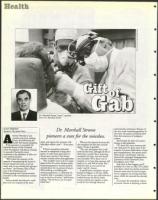
Dr. Marshall Strome "scopes" a patient.
Inset: Dr. Marshall Strome
ALAN ABRAMS
Special to The Jewish News
A
former Detroiter is just
months away from making
history by performing the
world's first larynx transplant.
If the operation is successful, Dr.
Marshall Strome of the Cleveland
.
Clinic Foundation will almost certainly
be assured of having his name
enshrined in the pantheon of 20th cen-
tury medical pioneers.
"We've done the majority of the
research of transplanting the larynx in
the last decade and more, so we are
ready, and we are awaiting the appropri-
ate donor," said Strome, who is chair-
man of the Department of
Otolaryngology and Communicative
Disorders at the world-famous medical
facility.
Strome already has selected a candi-
date to be the recipient of the trans-
Dr. Marshall Strome
pioneers a cure for the voiceless.
plant, and expects the operation will
take place within a year — if not soon-
er.
If larynx transplants ultimately
become as widespread as lung trans-
plants, it could mean good news to
throat cancer patients. But Strome
remains cautious about that application.
"You wouldn't want to do it (a trans-
plant) at first for cancer because of the
immunosuppression, because you'd be
worried about the recurrence of cancer.
We're looking at modifying the
immunosuppression, so ultimately we
would be able to transplant (a larynx)
even in the face of cancer," said Strome,
adding, "We still have a lot of unpub
lished data."
What are the chances of success for
the transplant the first time around?
Again, Strome is guarded.
"You can't presuppose that it will
work the first time, although I'd like to
think that it would. But it took lung
transplants 20 years, and now they're
very successful. We've done a lot of
research, so we hope that someone will
smile on us, and we'll be lucky. But I
think the time is now, and we are
ready," said Dr. Strome.
A partial larynx transplant was per-
formed in Belgium in the late 1960s,
but Strome said no one really believed it
worked because the blood vessels
weren't properly put together as they
would be now through advanced
microvascular techniques. Because of
the very crude immunosuppression of
that time, the patient ultimately died
from the recurrence of malignant
tumors.
But beneath the layers of caution,
Strome is still optimistic.
"If I don't do it now, someone else
will. And since I've done most of the
research, if anyone thinks about a laryn-
geal transplantation, they pretty much
think of me," said Strome, who has
directed the Laryngeal Transplantation
Laboratory of the Cleveland Clinic
Foundation since 1993.
And when it does happen, you'll
probably see it first on ABC-TV's 20/20
news show, which has closely monitored
Strome's career since he lent his exper-
tise to a segment on snoring and sleep
apnea, which the network has televised
twice.
To increase the transplant's chances
of success, Strome is requiring a donor
Scanned image of the page. Keyboard directions: use + to zoom in, - to zoom out, arrow keys to pan inside the viewer.
November 28, 1997 - Image 174
- Resource type:
- Text
- Publication:
- The Detroit Jewish News, 1997-11-28
Disclaimer: Computer generated plain text may have errors. Read more about this.