
demanding (and exciting).
I get many invitations to speak in
public and to travel. For example, I will
be reading poems relevant to public
events on "NewsHour with Jim Lehrer"
from time to time. The paradox of hav-
ing a "laureate," with the royal conno-
tations of that term, in a democracy
reflects the place of poetry in our cul-
ture: still being worked out, partly on a
European model and partly in new,
improvised ways.
•
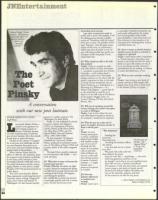
A conversation
with our new poet laureate.
LYNNE MEREDITH COHN
StaIT Writer
L
ast month, Robert Pinsky, a
teacher in the graduate cre-
ative-writing program at
Boston University, became
the 39th American poet to hold the
post of poet laureate. He is the seventh
Jewish poet to attain the honor.
Chosen by the Library of Congress
for a one-year term (although the last
two poet laureates have gone on to
serve two), each poet laureate brings a
special touch to the position.
When Maxine Kumin held the
office in 1981-82, she initiated a popu-
lar women's series of poetry workshops
at the Poetry and Literature Center.
Gwendolyn Brooks (1985-86) took to
the public elementary schools, encour-
aging children to write poetry. Joseph
Brodsky (1991-92) promoted poetry in
public places.
The most recent laureate, Robert
Hass, sponsored a week-long festival of
American nature writing, bringing 26
poets, story writers and essayists to
Washington. He also featured specific
11/28
1997
92
poems in a weekly column in The
Washington Post Book World.
Pinsky, 57, has published five books
of poetry: Sadness and Happiness
(1975); An Explanation of America
(1979); History of My Heart (1983);
The Want Bone (1990); and The
Figured Wheel: New and Collected
Poems, 1966-1996 (1996).
He also translated The Separate
Notebooks by Czech poet Czeslaw
Milosz, produced an acclaimed transla-
tion of The Inferno of Dante (1994) and
is poetry editor of the online magazine
Slate.
The Jewish News recently conducted
its own interview with Pinsky — via e-
mail, of course.
JN: What does it mean to become the
nation's poet laureate?
Pinsky: Officially, the duties are light:
to give a lecture or reading each spring
and fall and to arrange the lectures and
readings at the Library of Congress,
introducing the speakers.
But unofficially, as poetry has become
increasingly popular and vital in recent
years, the post has become more
JN: What would you like to do with
this position?
Pinsky: I hope to compile an audio
and video archive of many Americans
— not poets, in particular, but all sorts
of people — each reading aloud a
poem that person loves, and maybe
saying a sentence or two about why the
poem is important or dear to the read-
er. If any of your readers has, say, an
Emily Dickinson or a Shakespeare or a
Browning or a Whitman — or a
Moshe Leyb Halpern — poem that he
or she would like to read for me, I
hope he or she will write to the director
of this project: Maggie Dietz, do
Creative Writing, 236 Bay State Road,
Boston, MA.
a nominally Orthodox household, one
profoundly infiltrated by the secular
and sensual goodies of the world
beyond Judaism. I have found the con-
flicts inherent in that situation to be
rich ground for thinking about culture,
individual desire, etc.
JN: Does it matter to Jewish America
whether poetry by Jews is cultural vs.
religious or spiritual?
Pinsky: I don't know what is important
to "Jewish America" (the phrase may
denote a real entity, but I'm not sure). I
think it is up to the reader, not me, if
he or she chooses to find cultural or
spiritual force in my writing, or chooses
to make that distinction, or not.
JN: What are you currently working
on?
Pinsky: I am writing a new book of
poems, and also a little (maybe 100
pages) prose book titled A Brief Guide
to the Sounds of Poetry in English.
❑
JN: Will you be speaking around the
country during your tenure? Any plans
to come to Michigan?
Pinsky: I was in Ann Arbor last year,
and while there is no plan to return at
the moment, I would not be surprised.
JN: What do you see as the role of
poetry in modern American society? Is
there a role for poet-
ry?
"The Sentences"
Pinsky,: In every
society, poetry gives
Reading the
a certain, combined
sentences,
physical and intellec-
On the cover of
November sun.
tual comfort or plea-
Touching the avenues, offices, Pinsky's "The
sure: It is an art of
Figured Wheel"
the station,
the body and the
I saw you pass me on a street, is Torah Ark,
mind. In our society,
Jerusalem,
your face
with its powerful
Was pink with cold, cold win- 1923-25.
(often brilliant) cul-
dows flashed, the stores
ture on a mass scale,
And cars were like — mythology —, the street
the intimate, person-
Itself was glamorous and lost, it was
al nature of poetry's
As though I never knew you yet somehow knew
medium — a single
That this was you, a sentence interdicted
human voice —
The present, it said, you never knew, you passed,
seems to be especial-
Leaves coppery and quick as lizards moved
ly valuable.
Around your delicate ankles; November sun
N;S"
JN: How has
Judaism influenced
or inspired your
writing?
Pinsky: I grew up in
CR1?
Lay on the sidewalk, ordinary and final
As the sentences too flat for any poem.
— from Sadness and Happiness by
Robert Pinsky (1975)
C
Scanned image of the page. Keyboard directions: use + to zoom in, - to zoom out, arrow keys to pan inside the viewer.
November 28, 1997 - Image 152
- Resource type:
- Text
- Publication:
- The Detroit Jewish News, 1997-11-28
Disclaimer: Computer generated plain text may have errors. Read more about this.