

C
ach Friday
before sunset,
wherever there
are observant Jews, an
ancient culinary ritual
transpires. The making
of cholent, the tradi-
tional Shabbat casse-
role eaten after
Saturday-morning ser-
vices, boasts an impor-
tant culinary standing
in Jewish culture.
Cholent-type meals have, for thou-
sands of years, fed hungry Jews
instructed by the fourth.command-
ment to "remember the Sabbath day
and to keep it holy."
Part of keeping the Sabbath holy
involves the forbiddance of work.
Thus, no actual cooking may be per-
formed on Shabbat. Among the 39
activities determined to be work,
lighting fires, cooking and baking are
strictly prohibited according to
Jewish law. Historically, the loophole
in these restrictions has been to slow
cook all-in-one stews over fires that
had been started before the 18 min-
utes preceding sundown, which sig-
nals the onset of Shabbat.
Cholent is a basically a stew. This
concoction of meat or poultry, veg-
etables, legumes, combined in a pot
or covered casserole, is placed in a
slow oven or over low heat and
cooked for 12 to 20 hours.
Individual cholent ingredients
vary, reflecting availability and
affordability as well as personal taste
preferences. The traditional
Ashkenazi version, however, includes
brisket, potatoes, barley and fava or
white beans.
Around the world, cholent has sev-
eral names and variations. Although
the origin of the word cholent is neb-
ulous, one common thought is that
the medieval word is a variation of
the Old French word chault or
chauld, meaning "hot," and lent,
which translates into "slow." Another
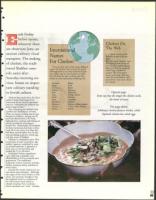
Opposite page:
Some say that the longer the cholent cooks,
the better it tastes.
This page, below:
Ashkenazi cholent features brisket, while
Sephardi cholent has whole eggs.