

AWL
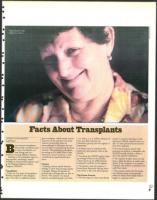
Maya Rybak smiles
despite her illness.
•
Facts About Transplants
LONNY GOLDSMITH
StaffWriter
•
B
one marrow transplants,
historically considered only
in cases of leukemia, are
now being used as a
method of curing different diseases.
Getting to the transplant stage is a
long process, involving a search
through an international registry such
as the National Marrow Donor
Program (NMDP).
Transplants:
• There are two types of transplants.
Rybak's transplant is the allogenic
n type. The other is called an autolo
„
gous transplant, which entails remov-
ing some of the patient's own bone
marrow giving high doses of
chemotherapy to eliminate the can-
cer, and then re-introducing the bone
marrow The autologous transplant,
according to Dr. Jared Klein of the
Karmanos Cancer Institute, is still
considered an experimental treat
ment.
Donors:
• Finding a donor match between
siblings is easier than among unrelat-
ed people. Almost 30 percent of
patients have siblings who are able to
donate. The chances of a match
between unrelated people vary from
1 in 100 to 1 in 2 million. Because of
that, says Rob Schweers of
Karmanos, getting into the registry is
important.
• A donor must be someone who
shares the same genetic code as the
patient.
• Searching the NMDP registry takes
an average of four to six months.
There can be up to 2,000 patients
looking for matches in the registry.
• The genetic code of a patient is
found most frequently among mem-
bers of his or her own ethnic group.
,
The Donor Process: .
• The first step is to have your blood
typed. It requires drawing a small
amount of blood, which is sent to a
lib. It's then processed and entered
into the computer.
• If you're found to match with
someone in need of a transplant, the
NMDP would schedule a time to .
have the marrow withdrawn.
• The marrow is taken from the hip 4
,
bone, while the donor is under anes
thetic. If the recipient is at another
location, the marrow is packed in ice,
and flown there.
• The marrow enters the the recipi-
ent's blood stream intravenously,
where in about three weeks time it
begins to replicate itself. El
:44.4016664
, 0
.
164i
10/17
1997
9