

g 1 Cr
'0 /1 i
Reupholstery & Refinishing
"A Family Tradition of fine Craftsmanship"
SOFAS • CHAIRS
RECLINERS
CUSHIONS
HIDE-A-BEDS
DINING CHAIRS • NEW FOAM
A Witness Remembered
WE DO REPAIRS!
U-M Professor Ralph Williams lectured on the legacy
Call Today 248-855-0885
50% Off ffill [Roam SPECIAL
Room
Chair's
frams 29.95
IN-STOCK
FABRICS
W/Coupon • Expires 10/31/97
Reg. $59.95
L W/Coupon • Expires 10/31/97
UNDER
ONE ROOF
Rochelle Imber's
------------ - -
Knit,
IMIM
.11113 Mil 10E11 I
■
MN MN M•111 II
■ 1
ACCENTS
IN NEEDLEPOINT
Contemporary
Designs
626-3042
IN THE ORCHARD MALL
WEST BLOOMFIELD
181 S.•Old Woodward Ave.
(I Rik. S. Of Maple, Next to the
Birrnin.11tam Theatre)
Mon.-Sat. 9:30-5:30. Thurs. tit 8:30
(248) 642-169()
DETROIT
JEWISH NEWS
10/17
1997
10
CLASSIFIEDS
GET
RESULTS!
Call
(248)354-5959
of writer and Holocaust survivor Primo Levi.
SUSAN TAWIL
Special To The Jewish News
I
n his book, The Murderers Are
Among Us, famed Nazi hunter
Simon Wiesenthal writes of an
SS guard who sadistically
assured him that the world would
never know about the atrocities of the
concentration camps.
"The Germans will win the war,"
the guard said, "and there will be no
survivors to tell of it. Even if there
would be a few survivors, the evidence
will be destroyed, and
no one would believe
them." And, the guard
continued, "even
should some proof
remain, survivors
would still not be
believed; the events
they would describe are
much too monstrous
to be believed."
The Germans lost
the war, and much evi-
dence was, in fact,
destroyed. But memory
cannot be killed off.
Survivors like the late
Primo Levi kept the
history alive in his dis-
passionate writings.
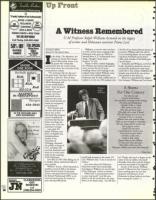
Last week, Dr.
Ralph Williams, pro-
fessor of English and
Interdisciplinary
Studies at the
University of
Michigan, discussed
the prolific writings of
Levi, an Italian who
survived Auschwitz and
went on to write exten-
sively on the meaning
of the Holocaust.
Levi died in 1987 after falling out of
a window. Many authorities believe it
was a suicide.
Williams' lecture, which attracted an
overflow crowd of 200 at the Jimmy
Prentis Morris Jewish Community
Center, was sponsored by the Institute
for Retired Professionals (IRP), a cul-
tural and social group for retired or
semi-retired professionals.
Williams, a non-Jew who was born
in 1941, said he knew nothing of the
Holocaust as he grew up. When he
learned about it, it "contravened every-
thing I thought I knew about
humans," he said.
Fluent in about a dozen languages,
Dr. Williams has lived in Italy part of
every year for the last 25 years.
Studying Primo Levi's writings in the
original Italian helped Williams come
to terms with understanding the
Holocaust and, he feels, enables him to
explain it to the over 200 students who
Professor
Ralph
the fear of not being believed haunts all
survivors, Williams said. He told of
Levi's recurring dream: As he is speak- - <
ing about Auschwitz at his dinner
table, each member of his family gets
up and leaves.
Ironically, said Williams, Levi's first ri
book, Survival in Auschwitz, was not
accepted for publication until many
years after it was written. Publishers felt
people were tired of the war and no
one wanted to hear about it.
When Levi was asked if he forgave
the Germans, Williams said Levi retort-
For Our Cent :
Williams
You who live safi.
.yourwarm houses,
You who find, returning in the evening,
Hot food and friendly faces•
Consider if this is a man
Wbo works in the mud
Who does not know peace
Who fght s for a scrap of bread
Who dies because of a yes or a no.
Consider if this is a woman,
Without hair and without name
With no More strength to remember,
Her eyes empty and her womb cold
Like a frog in winter.
Think! This has been'
I command these words to you.
Carve them in your hearts
At home, in the street,
Going to bed, thing,.
Repeat them to your children,
Or may your house fall apart,
May illness strike yourfeet,
May your children.turn their fitces m you.
,
.
.
area Levi
enroll each semester in his course. Of
Levi, Williams said, "I am in moral awe
of him."
Levi wrote about the Holocaust
objectively rather than emotionally.
According to Williams, he was the first
of the Holocaust "writers as witness."
Gifted with "a monumental memo-
ry, near total recall," Levi felt com-
pelled to tell the world about his expe-
rience in the death camp. Levi felt that
ed, "Firstly, who am I to forgive in the
name of the six million who died?
Secondly, those who need the forgive-
ness have not asked to be forgiven!"
As part of the lecture, Williams
recited "A Shema for Our Century," a
heart-rending poem by Levi that
demands remembrance of the
Holocaust by those lucky to not have
been among the victims.
❑
0