
Business
• SHOWROOM HOURS
Mon-Fri 11 • 5
Sat 11 * 3
OR BY APPOINTMENT
• 248.624-7300
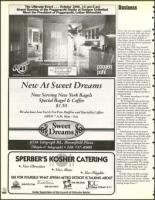
Now Serving New York Bagels
Special Bagel & Coffee
$1.50
We also have Low Fat & Fat Free Muffins and Speciality Coffees
OPEN 7 A.M. Mon. - Sat.
6558 Telegraph Rd., Bloomfield Plaza
(Maple & Telegraph) • 248-737- 8900
SPERBER'S
CATERING
•tir etv-Obvetion/
stirew--d/ienit/
SEE FOR YOURSELF WHAT JEWISH METRO DETROIT IS TALKING ABOUT
248-932-3766
10/17
1'17 /
148
Beth Abraham Hilki Moses
I
Ni Congregation Beth Ach;rrt
21103.J
44 -ftpc..07
gr•m 248-788-0950
248-357-2910
B'nai Moshe
Under Supervision of the Council of Orthodox Rabbis
248-661-5151
hives. The two men began to research
the field of livestock theft and discov-
ered that it was a major problem for
agricultural producers globally. In
Israel alone, about $1.5 billion worth
of animals and agricultural equipment
are stolen every year.
In October 1996, they founded
Shaked Wireless Control Ltd. at the
incubator in Ofakim. For the first two
years, they receive financial assistance
from the Office of the Chief Scientist. 1
Shaked's first target was the cattle
market. "This is one of the most
developed branches of the agricultural 11- ■
market and each cow is expensive,"
explains Korach. The concept of the
new system is simple. A small elec-
tronic collar is attached around the
cow's neck. This collar is linked to a
.1Io
central computer which monitors the
1
cow's movements. If someone tries to
break or remove the collar without a
special code, or the cow moves out of
s.
a pre-designated area such as the dairy
or a field, an alarm goes off. This
enables farmers to respond quickly to
attempted theft.
The system, according to its mak-
ers, is simple to use.
"It's developed for the dumb user,"
says Korach. Essentially it's a three-
part system: the collar, which has a
battery with a three- to five-year life
span; the antennas, which link the col-
lar to the computer and specially
developed software which can be used
on any normal PC. At any given
moment, the farmer can find out
through the central computer the
location of each cow, as well as extra
information about genetic heritage,
etc.
Korach plans to keep the system
cheap — installation of software and
antennas will cost about $1,000, while
each collar will be an additional $10.
Though the system has not yet
gone to market, a prototype has been
developed and is in use on several
farms around Israel. Work is now
going on to refine the product and
shrink the electronic collar. It should
be on sale by the end of this year.
As with all innovations, the most
difficult part is not creating it, but
marketing it successfully. The market
exists — globally some hundreds of
million cattle are being raised - but
Shaked's problem is how to reach
them.
Korach's plan is to find a strategic
partner that will help find the right
markets at home and abroad. Already
there has been enormous interest from
leading foreign firms. ❑
Scanned image of the page. Keyboard directions: use + to zoom in, - to zoom out, arrow keys to pan inside the viewer.
October 17, 1997 - Image 148
- Resource type:
- Text
- Publication:
- The Detroit Jewish News, 1997-10-17
Disclaimer: Computer generated plain text may have errors. Read more about this.