

/
/--
experience for the patient is similar to
/-2 having ultrasound.
/–
"We've already gathered data for
the FDA on this project and we're
starting a second with this same
machine to improve finding of tumors
because mammography doesn't always
locate all malignancies. We also want
to provide more specific information
about a site."
Another device expected to boost
diagnostic accuracy may spare many of
the 700,000 who undergo'breast biop-
sies each year. The FDA has approved
a digital ultrasound device for evaluat-
ing solid breast masses.
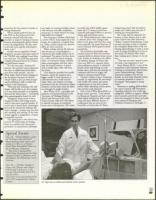
"For the most part, ultrasound's
primary role in breast cancer detection
has been to differentiate fluid-filled
cysts from solid tumors," says Dr.
Mark Segel, chief of breast imaging at
the Karmanos Institute in Detroit.
"Fluid within a cyst can then be aspi-
rated (withdrawn with a needle) for
analysis in the laboratory.
"With this new technique the radi-
ologist will be able to see the margins
of a mass that's partially or completely
obscured by dense tissue — something
that mammography doesn't do well.
"Malignant masses tend to have
irregular borders and benign masses
tend to have more smooth borders. If
a sold mass is found from mammogra-
phy and the ultrasound indicates the
mass is benign, a woman can then feel
safe watching and waiting. If the ultra-
sound suggests a malignancy, a biopsy
is probably essential.
"The good news is that about four
of every 10 solid lumps are benign.
Now, in a painless and noninvasive
procedure, an experienced radiologist
can single out common benign masses
with accuracy and offer immediate
reassurance to many women by using
high-definition imaging."
Not long ago, a woman didn't have
a choice when a lump appeared in her
breast; she underwent a surgical biop-
sy. Today, needle biopsies in a doctor's
office are more common.
When a lump can't be felt and can
only be seen on a mammogram, a
stereotactic fine-needle biopsy can be
performed. The patient lies face down
on a table with her breasts hanging
down. A stereotactic biopsy machine
takes mammograms and then calcu-
lates the lump's location. A device
with a needle takes a few cells from
the lesion.
Core biopsies resemble fine-needle
biopsies, except the surgeon uses a
bigger needle. A local anesthetic is
administered and a small incision
made. More core biopsies are being
performed with the stereotactic biopsy
machine; several tissue cores are taken
out through the single incision.
Max Wicha, M.D., oncologist and
professor of internal medicine at the
University of Michigan Medical
School and director of the U-M
Cancer Center, talks of U-M's efforts
to identify the genes in hereditary
breast cancer development. His center
recently won a $6.2 million grant
from the U.S. Army to fund new
research and expand efforts to prevent,
detect and treat breast cancer.
Dr. Wicha believes that when more
is known about what changes take
place in the genes and why they cause
cancer growth, the major direction of
cancer research will be geared toward
prevention.
He envisions a genetically engi-
neered vaccine to boost the immune
system's ability to destroy breast cancer
cells. Studies are looking at the effects
of radiation therapy on breast cells
that carry BRCA-1, a genetic defect
that predisposes women to inherited
breast cancer and finding out why
breast cancer cells become resistant to
treatment and how to trigger cell
death in cancerous breast tissue.
October is Breast Cancer Awareness
month, an opportunity for area hospi-
tals, health care centers and cancer
organizations to tout their achieve-
ments while informing women about
the need for early detection.
-Fran Cook of West Bloomfield is a
breast cancer survivor. "I was treated
at Beaumont Hospital and had a mod-
ified radical mastectomy after confer-
ring with three different doctors. I
understood that my survival rate
would be no better than if I had a
lumpectomy, but I had 12 positive
nodes and I didn't want the risk of
making the wrong decision."
Ms. Cook says it's important for
women to have choices and to take
some control over their treatment.
"Before I started chemotherapy, I had
my hair cut short so that it wouldn't
be a complete shock when it fell out.
During chemotherapy, I made a ritual
every evening of brushing my hair so
that most of it fell out then rather
than waking up to clumps on my pil-
low.
"This was one way I stayed in con-
trol and it was important to me."
Stuart Ratner, Ph.D., is one of the
researchers at the Karmanos Institute
working on information about breast
cancer immunotherapy. Despite
impressive progress over the last
decade, he sees many obstacles before
an immune response to cancer is
developed, "but progress is being
made."
Karmanos is seeking $100 million
for cancer research. Bill Davidson's
Guardian Industries two weeks ago
pledged $1 million to support collabo-
rative research, prevention and early
detection programs in breast and pedi-
atric cancers at Karmanos and
Children's Hospital of Michigan.
❑
Oct., 20
Kit
Mer,, :au
of To Dance *. the evil"
about battling breast cancer, will
speak at 11:30 a.m. at Temple
Israel, West Bloomfield.There
fee of $36.p114:::
The event is
by
DIACSinai:ospital and the Sinai
Hospital GUM, in affiliation. with
the Barbara Ann Karmarios Cancer
Institute.
Oct. 29 -- "Mother, Daughter,
Sister, Self: Women and Cancer"
will be held 7-8:30 p.m. at the
Livonia West Holiday Inn (1-275
and Six Mile).
The event is free and sponsored by
the U-M Comprehensive Cancer
Center.
Dr. Segel uses an ultrasound machine with a patient.
10/3
1997
89