

Focus
'E.
0
0
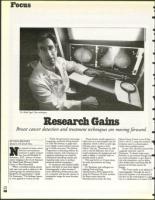
Dr. Mark Segel: New techniques.
Research Gains
Breast cancer detection and treatment techniques are moving forward.
RUTHAN BRODSKY
Special to The Jewish News
N
ew research in breast cancer
detection and treatment
continues to gather momen-
tum. Just ask Michelle D.
Rossmann, M.D., director of breast
cancer imaging at the Cis & Emanuel
M. Maisel Sinai Women's Health
Center in West Bloomfield.
"When I attended medical school,
only men were used as subjects in the
control groups for research projects
funded by the government," recalls
Dr. Rossmann. "The findings, howev-
er, were applied to women as well.
•
•
"Today, the government encourages
companies, previously doing business
in Cold War defense, to apply their
once highly secured military technolo-
gy to health care areas. The Defense
Department is allocating millions for
medical research, and companies are
applying technology once used for
seeking and destroying missiles and
mapping target areas, to produce
advanced medical equipment."
Dr. Rossmann says artificial intelli-
gence will likely be used when digital
mammography is place because it
more efficiently provides precise data
to a computer and has the capacity to
manipulate images for more accurate
analysis.
10/3
1997
88
411110111111111111111111110111111.1111111111.111111111111111111.10
-41b- 4111111111m,
"Breast density usually appears as a
white area on a mammogram and cal-
cification, which is often an early sign
of breast cancer, appears a little
whiter," she says. "Sometimes it's diffi-
cult to tell the difference. But if one
could manipulate the background and
make it darker, it would be easier to
identify which is which."
This may be five or 10 years down
the road, but advances are being
made.
Dr. Rossmann and colleagues are
seeking Food and Drug
Administration (FDA) approval for
using the Transscan (T-scan) machine
for breast cancer detection.
Manufactured in Israel, the Sinai
Breast Cancer Center is one of four
sites in the U.S. using the machine. It
evaluates areas in a mammogram
which show possible tumors.
'At one time, all breast tumors were
surgically removed," says Dr.
Rossmann. "It doesn't make sense,
however, to put women through such
an evasive procedure, to put them at
risk with anaesthetic, and to . deface
their bodies when something like 80
percent of all breast tumors are
benign.
"The T-scan works as an adjunct to
mammography. Through the use of
electrical impulses it can determine if
the spot on the mammogram is a den-
sity or a calcification or a tumor. The