

The BiG Story
Round 8t. Round We Go
How a famed artist celebrates and remembers the circle of time.
Mae Rockland Tupa
Special to The AppleTree
W
European immigrants while growing 7
:
up in the Bronx in the '40s and
'50s that time was linear. Time start-
ed at The Beginning, (Adam and
Eve, dinosaurs, cave men or the
Big Bang, depending on my age
and stage), and moved along year
after decade after century, always
c-7
marking progress.
Our family exemplified this notion
of linear progress. My parents
came from somewhere over-
seas, which deteriorated and
disappeared during World
War II and its aftermath, just
as America blossomed into
world leadership. On my daily
walks through "Dinky Town" to
Jones Hall at the University of
Minnesota during the late
1950s, I marveled that I, the
small, dark-haired daughter of
European Jews, could be attending
college along with the tall, blond
Vikings whose families also had
come from somewhere else, albeit
earlier.
e have a tradition in o Ur
family of goldeneh
hendt golden hands.
In every generation, there are
some of us compelled to make
things. In Eastern Europe, we were
carpenters, potters, sign painters,
tailors and seamstresses. Here,
we've been cartoonists, potters,
architects, designers, painters.
Although I never met her in
person, my Bubbe Chaya Fiegel
taught me to sew when I was
young. She was "lost during the
war," my mother told me, "with
all the other Jews."
Because I wanted so badly to
know her, I endlessly studied the
two pieces of Chaya Fiegel's
needlework, which my mother had
brought with her when she left
Poland in 1922. From them, I
learned the mysteries of various
stitches, applique and color layout.
Like many contemporary families,
mine is spread across the country.
While we may be together in spirit
and are blessed to be able to hear
one another's voices on the phone
it is rare that we can all be in the
same town for a holiday or event.
Mae Rockland Tupa is a multimedia
artist now concentrating on writing and fab-
ric art. She is the author of The New Work
of Our Hands (Chilton, 1994), The
Hanukkah Book (Schocken, 1975 and
7985) and The New Jewish Yellow Pages
(S.B.S. 1987). Her art work is in both pri-
vate and public collections including the
Jewish Museum in New York, the Skirball
Cultural Center in Los Angeles and the
National Library of Spain in Madrid. She
lives and works in New England and the
community of Valencia, Spain, with her hus-
band, artist and teacher Myron Tupa.
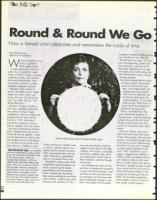
Mae Rockland Tupa's spiral beaded challah cover.
When working on a challah cover
or quilt for someone dear to me, I
literally feel the love go into every
stitch, knowing that each time my
child, child-in-law or grandchild
uses it, I am close to him or her.
I decided to employ some of this
sympathetic magical presence via
touch to conjure up the distant
grandchildren and their parents
when I needed them by having
them make something for me which,
when finished, would bring to mind
everyone who worked on it. This
way, the whole family would be
together at one table for the High
Holidays. The project, I concluded,
should be a challah cover, which
we would use for the first time on
Rosh Hashanah, and then through-
out the year.
As I pondered the nature of time
and how to translate the concept to
a visual and tactile statement, I real-
ized that over the past half-century
my perceptions of time have under-
gone considerable change. It was
clear to this eldest child of eastern
When my children were small, I
didn't think much about the nature
of time and progress. Like most new
parents, I just wanted enough hours
in the day to survive while learning
the skills of my new role. If people
at dinner parties bothered to ask
what I "did," I told them I was a
juggler. I juggled three children, a
husband, and a household with my
own needs to make art and write.
Since I couldn't spend much time in
the studio, I devised projects I could
carry around with me and work on
while watching the children in the
playground or waiting for them at
ballet. The portable projects that
were easiest to work on in bits of
time usually involved sewing.
c--/
('
<