

Choosing Their Religion
A Jew and a Catholic find their common ground in community activism, and a respect for each other's faith.
JULIE EDGAR SENIOR WRITER
L
isa Tann has always been involved in Jewish com-
munal life. She spent her summers at Habonim Dror,
the Zionist youth camp in northern Michigan. Her
family attended the Jewish Family Institute, where
Lisa taught graduating students. She served as presi-
dent of the B'nai B'rith chapter at Western Michigan Uni-
versity, and, in that role, endured death threats at the
beginning of the Palestinian intifada.
Always civic-minded, Lisa joined the Farmington
Jaycees two years ago, and promptly fell in love with E.
Mark Blasiola, a product of years of Catholic school-
.
ing.
-
She said she knew almost immediately that Mark
would become
become her husband, although his "quintessen-
tial moment" came a few weeks later. Since then, the
pair have been inseparable.
On Saturday, the two will wed under a chuppah at a
local hotel. Rabbi Harold Loss from Temple Israel, whom
the couple count as a good friend, will officiate.
"We wanted to wed on neutral ground. It was proba-
bly the easiest decision for us to make," Lisa said.
Mark attributes some of his comfort with Judaism to
Rabbi Loss, whom he said welcomed them both, and made
time to answer their questions, whenever they had them.
Mark also read a book the rabbi lent him, What Is A Jew?
He said he wants Rabbi Loss to be a part of their life.
"I thought Judaism was a religion of exclusion because
of the hangup about intermarriage," Mark said. "Now,
I understand."
But he has no plans to convert to Judaism. Lisa has
no plans to ask.
Once, after a visit to Lisa's cousin, whose non-Jewish
husband had decided to convert, she told Mark she'd nev-
er demand that he do the same.
"To me, it's not right to make somebody do something
he's not comfortable with," Lisa said, adding that she also
didn't want to lose Mark.
For his part, Mark, 36, considers himself strongly re-
ligious. He adheres to the notion of absolution from sin,
and any discussion of spiritual matters "lights my in-
ner fire," he said. He finds Judaism "fascinating."
"Even buying an inexpensive kipah excited him," Lisa
said.
CC
LI-I
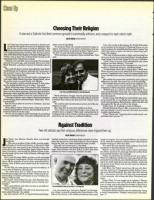
Lisa Tann and Mark Blasiola: Just starting out.
Mark admitted, though, that he always fantasized
about a huge church wedding with bells and all, and said
it bothers him when Lisa uses the term "Jesus" as an
oath.
"Pm not the most sanctimonious person, but I like my
religion," he said.
But, they plan to raise their children as Jews.
"One of the most important things to me is that my
children have a religion," Mark said, noting that he is
reading a book on the confusion children face when their
parents do not rear them in a defined tradition.
Lisa, who works at the Agency for Jewish Education
as an assistant to the director of Stepping Stones, an out-
reach program for interfaith families, said it "scares" her
when she meets couples who haven't raised their chil-
dren with religion.
'The rate of intermarriage is high, and knowing how
Jews are slowly becoming assimilated, Jewish people
aren't going to be Jewish, except for the very Orthodox.
"I don't want to be part of the assimilation rate where
children lose their identity," Lisa said.
When she announced her engagement, her grand-
mother, a Holocaust survivor, was disconcerted.
"I understand where she's coming from," Mark said.
When she and Lisa's aunt asked him if he was going to
convert, "I explained why I won't, but assured them we'll
have a Jewish home and our children will be raised Jew-
ish."
His mother has never been troubled by their religious
differences, he said. She loves Lisa, as do his siblings.
The couple's home in Novi has but one religious sym-
bol — a mezzuzah by Israeli artist, Agam, that is en-
sconced in a frame atop their entertainment center.
"If Mark put up a picture of the Virgin Mary, I'd be
very uncomfortable," Lisa said. Nor is she comfortable
with the idea of a Christmas tree, although she and Mark
have discussed it.
In fact, being with Mark has intensified Lisa's inter-
est in Jewish life. It was Mark who suggested that she
work at Congregation Beth Shalom, which she did, and
she applied for the job at AJE at his behest.
Today, Lisa, 30, is taking a course in Hebrew.
Should Stepping Stones offer a program for couples
who are dating or newly married, she said, she would
consider participating.
`Td go," Mark said. "Anything that would smooth over
problems that crop up."
❑
Against Tradition
Two old radicals say their religious differences never tripped them up.
JULIE EDGAR SENIOR WRITER
J
and last worked as a substance abuse counselor in a hos-
pital, had never met a Jew before Sharon. He recognized
her by the "kai" on a chain around her neck, he said.
"You still can't pronounce it," she joked.
While her parents were deeply pained about their mar-
riage, Joe's parents were fine with it. In fact, they were
relieved he wasn't marrying a Catholic, he said.
PHOTO BY DANIEL LIPPITT
oe Petty was Sharon Hecht's first non-Jewish
boyfriend.
She was a product of the solidly Jewish neigh-
borhoods of northwest Detroit, a Mumford High
School grad who was reared in an Orthodox home. Joe,
whom she met in a psychoanalytic theory class at Wayne
State University, was among the different kinds of peo-
ple who made up her new circle of friends, although most
were Jewish.
But, it was the early 1960s, and she was 25 and single
— an explosive combination. People were beginning to
throw off the shackles of social mores and parental au-
thority. Few of their peers cared much for social con-
vention.
"In the '60s, you were trying to get rid of tradition. It
was a time of anarchy," Sharon said.
Yet, when they wed in 1963, surrounded only by
friends and a judge (who was Jewish), 'There was an un-
derstanding I wouldn't participate in any Christian tra-
ditions," Sharon said.
She hasn't. And neither has Joe, who describes him-
self as an "agnostic intellectually and an atheist emo-
tionally."
"He's a non-believer, and when you have a non-believer,
it's better," Sharon said.
'We're very compatible. We both love to travel and we're
both radical liberals," Joe added.
Joe, who earned a Ph.D. in experimental psychology,
Joe and Sharon Petty are political, not religious.
Joe was reared as a "primitive Baptist" in Farming-
ton, when it was still a patchwork of small farms. The
folks at the church of his childhood believed they could
speak in tongues. Joe cut himself off from the tradition
at 15, when he overheard a debate about which heaven
blacks would go to when they died.
"I've never felt any tension along religious lines from
my family or Sharon's family," he said.
Sharon, on the other hand, said it wasn't until their
son, Ebon, was born 31 years ago that her mother final-
ly reconciled herself to the marriage.
Today, Joe describes his mother-in-law as a "saint."
When he suffered a stroke four years ago that left him
paralyzed on his left side, she retrofitted most of his cloth-
ing so he could easily get in and out of them. At 90, she
has grown more liberal, but she still observes Shabbat
and keeps kosher.
Like Ebon, the Pettys' second son, 26-year-old, Seth,
was bar mitzvah at Congregation Beth Achim. Grow-
ing up in West Bloomfield, they did what their friends
did — become bar mitzvah. But, they also were exposed
to Joe's parents, who always got them Christmas pre-
sents.
Today, Ebon "is very caught up in religion," Sharon
said. He gave her a copy of The Secret War Against The
Jews to read, and even asked his bubbie to give him a
mezuzah when he bought his house, Sharon said, with
the smile of a proud mother.
Joe said he always tried to raise his children by "being
a moral, honest person." Religion wasn't part of the equa-
tion.
❑