

and the laid-back feel of the South. The Jews
have been well accepted there by gentile
neighbors.
Bob Sherman belongs to the local country
club, whose membership is 7-8 percent Jew-
ish.
When the new club was built 37 years ago,
it changed its "token Jews" policy and opened
membership, Sherman says. "Now, Jews are
very active. There have been four Jewish
presidents [of the club] in that time."
The fences dividing the three Jewish ceme-
teries in Bay City were removed to form one.
At the north end are the Reform graves,
"some very old gravestones," Ralph Isackson
says. At the south end were buried the Or-
thodox Jews, and in the middle are the Con-
servatives, he says.
Just as the divisions between graves have
been erased, "that's the way the communi-
ty went here," Isackson says.
The Latvian Jews comprised "a very ob-
servant community," says Sherman, where-
as the German Jews who came in the 1880s
preferred Reform. But eventually, members
of Bay City's Shaary Zedek "felt it was too
Orthodox for them, broke away" and became
Conservative.
Today, the members of Bay City's Temple
Isackson, who was born in the Upper Penin- Israel, which was built in 1961, are mostly
"families with kids who have grown and gone
sula town of Manistique in 1920. After his fa-
ther died in a 1921 auto accident, Isackson's away," says Bennett Ruby.
But the younger generation of Bay City's
mother moved back to Bay City.
"There aren't many families whose chil- Jews still feel that special Jewish something.
dren come back here," he laments. "They go Ruby's 15-year-old son Brian "has a real sense
ofJewish identity. His closest friend here is
where the action is, and it's not here."
Some new people do move to Bay City — Jewish," and he is happiest when talking
doctors, business people who "land here by about camp (Young Judaea).
"My son and two others are trying to or-
accident," he says.
But mostly, people return only for family ganize a youth group with the computer,"
businesses, like Bob Sherman's daughter, connecting Jewish youngsters in the Tri-
Patti Ruby. She brought her husband, Ben- Cities, Flint and Mt. Pleasant. Still, Bennett
nett Ruby, back home, and both now work Ruby says it's "not enough."
Sherman, says, "I can't be optimistic, I wish
with Bob Sherman at Sherman and Sons,
Inc., a shoe retailer founded by Bob's father, I could, but I can't be optimistic that the Jew-
Julius, in 1936. Sherman and Sons now op- ish community will grow or even maintain."
Beth Cook came to Bay City 24 years
erates shoe departments in stores like Crow-
ago with her husband David, a Bay City na-
ley's and Ganto's and specialty shoe stores.
Bob Sherman was born in Bay City in tive. By the time their children were old
1923; his parents originally came from Riga. enough, the Jewish youth group had been
disbanded. But their daughters — Rebecca,
In the 1880s, logging was big in Bay City and
attracted immigrants who brought no par- 25, and Amy, 22 — did receive a Jewish ed-
ucation.
ticular trade or vocation.
'We tried to give them as much Judaism
The people Sherman remembers from his
as possible in the home, sent them to camps.
childhood were peddlers. "I had a great-un-
cle [who had a] wagon and horse, would go They each had one Jewish friend," Cook says.
"I think in any community today, there is the
up north with pots and pans, farm to farm,
sell, barter, trade a pot for animal hide and same threat of assimilation and intermar-
back here sell the skins," he recalls. Many riage because children don't stay home any-
hawked fruit, rising at 4 a.m. to go to the mar- more, even more so here because we don't
ket to load their wagons with produce, then have a strong community to back up the fam-
walked the streets all day selling door-to-door. ily."
Cook was a supporter of creating the joint
The Jewish immigrants who settled in Bay
City were "entrepreneurial people," Sherman Congregation Am Yachad. "I wanted to see
recalls. Like the Bernstein family, who an eventual merger ... We've come up
opened silent movie theaters. And Koffman. against so much resistance, mostly in Mid-
and Blumenau, originally a malt company land and Bay City, that we had to abandon
that plan."
and later a grocery supplier.
Does that disharmony forecast the even-
Bay City used to be a place of "distinct Jew-
ish neighborhoods," says Andrew Rogers, a tual demise ofJudaikn in the Tri-City area?
musician who lives there now. It reached its Cook says it does.
"As soon as Rabbi Scott retires, I feel we
peak in the early 1940s, Sherman says.
"When I was growing up, we had a thriving will not be able to replace him, and whatev-
Jewish community — hundreds of families, er cooperation we have will fall apart. Merg-
parties, lots going on. Probably you had your er is the only solution."
Sherman says, "You have a community
World War and I think a lot of the popula-
tion found out there was another world oth- like ours, which has a very beautiful, large
synagogue, built with contributions and not
er than Michigan."
Bay City is a town of big, majestic houses cheap to maintain."
synagogues, two kosher butchers and one
kosher bakery.
Today, 70 families belong to Temple Israel.
Bay City's Jewish community comprises
mostly the descendants ofJewish immigrants
from Riga, Latvia, who came to mid-Michi-
gan in the late 1800s.
Ralph Isackson's mother, Lillian Biller,
was born in Bay City in 1890. Her parents
left Riga in 1880 to avoid conscription into
the Russian Army.
"My grandmother Biller, after she moved
here, her home became a place for Jews," says
And, Ruby notes, who will the three teen-
aged Jewish boys in Bay City date? Ralph
Isackson's daughter, a lawyer in Miami
Beach who married a Cuban man, sends her
children to Jewish private school. His step-
daughter married a Jewish man, but his step-
son married a gentile — "I don't know what
his kids will be," he laments. Small-town Jew-
ry builds strong identity but, sometimes, must
deal with an equally strong threat of inter-
marriage.
"Some people overlook the advantages of
a small community," Cook says. They build
"personal feeling, a feeling of belonging and
identity, which you might take for granted
in a larger community.
"Even with all our problems and dis-
agreements, we're still together in some way,
and I have to be optimistic about that," Cook
adds.
Rabbi Scott insists that "everybody
from the rabbi on down has to make com-
promises. [We must ask] not are we all ha-
lachic? But do we want to be together as
Jews?"
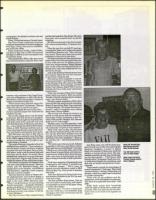
Above left: Bennett Ruby,
Bob Sherman and Patti
Ruby: Family business.
Top: Beth Cook wants to
see a Tri-Cities merger.
Above: Naomi and Verne
Primack: Keeping Judaism
alive in Saginaw.