
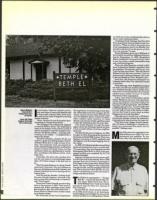

Above: Midland's
Temple Beth El:
Folding chairs and a
lot of pride.
n its heyday, Saginaw's Jewish commu-
nity was home to nearly 250 families and
a large youth program. Many Jews came
to service the needs of Saginaw's thriving
lumber industry.
Lower right: Ralph
Today, between 60 and 65 member fami-
Isackson: Part of Bay
lies belong to Temple B'nai Israel.
City's Jewish roots.
The synagogue was meticulously designed
to connote biblical times. The carpeting in
what is the largest Judaic library north of
Detroit is striped to resemble Joseph's color-
ful coat. The library ceiling — long logs criss-
crossing in the middle — is designed like a
tent in the desert.
The Book of Exodus, chapters 35-40, was
used as a guide in building design: God de-
scribes to Moses how to make a house of wor-
ship. The sanctuary walls are paneled in
heavy-textured beige material, recalling the
draped curtains of Temple times, and the
sanctuary chairs are upholstered in vermil-
lion, according to the biblical call for a bril-
liant color.
Ironically, the Jews who worship here
are the only ones to overwhelmingly agree
that a Tri-Cities merger is the best way to
go.
That's because Saginaw is a dying Jewish
community, Scott says. The city's reliance on
the ever-shrinking automobile industry and
related industries has Jews leaving and not
looking back.
Over the past few decades, "a string of rab-
bis came through Saginaw, and most of the
city's young Jews moved away or intermar-
ried," Scott attests.
Naomi and Verne Primack moved to Sag-
inaw in the summer of 1959. Their house is
packed with Judaic paintings, music, books
and sculpture; they eat only kosher food —
Naomi drives to Detroit once a month to stock
up on kosher meats.
The Primacks always have emphasized
I
the importance of maintaining Jewish iden-
tity. When their sons were younger, the Pri-
macks would invite the entire football team
over for Shabbat dinner, before the game.
Their children spent summers at Camp
Ramah, and one son invited a girl from camp
to stay the weekend and be his prom date.
Few Jewish families live near the syna-
gogue where the Primacks attend services;
it is in a mostly African-American neighbor-
hood now.
The first Torah came to Saginaw in 1884,
brought by Dora Rosenberg for services at
her house on South Fifth Avenue. That year,
Saginaw was home to 75,813 residents, and
the Saginaw was the busiest logging river in
the nation.
In 1890, 14 Orthodox families formed B'nai
Israel and conducted services in a rented hall.
Two years later, they were davening over the
Baumgarten Shoe Store. In 1913, a new syn-
agogue building was completed. By 1917, 25
families belonged.
Saginaw's Jewish community grew rapid-
ly in the first half of the century and in 1942
changed from the Orthodox Congregation
B'nai Israel to the Conservative Temple B'nai
Israel. The city of Saginaw kept expanding
through the '60s, and the synagogue followed
suit. But by the end of that decade, the pop-
ulation was declining as youth went away to
college and did not return.
T
he Midland congregation — Temple
Beth El — is the most liberal of the Tri-
City shuls, Rabbi Scott says. He be-
lieves Midland has a "much more viable
population than the other two, because of
Dow Chemical."
Temple Beth El, which recently celebrat-
ed its 40th anniversary, is an innocuous,
small building, almost hidden by trees. Its 55
member families sit on folding chairs. The lot
on which the musty-smelling facility sits bor-
ders a water-treatment plant.
Congregant Rudy Salinger describes Beth
El as somewhere between Reform and Con-
servative. "What you find in the small cities
is the congregations tend to be officially Con-
servative and sort of run the gamut, go their
own way anyway," he says.
Stuart Bergstein grew up in Midland af-
ter his father moved from Highland Park dur-
ing the Depression. In 1930, Bergstein's
father established Community Drug, which
is now two stores, a small prescription shop
and a full-size drugstore.
When the elder Bergstein settled in Mid-
land, he faced anti-Semitic opposition from
his neighbors. The attitude, says his son, was,
"Let's run him out of town." The only Jews in
Midland in the '30s were a jeweler, a shoe re-
pairman and a clothing salesman, who most-
ly did not identify as Jews, Bergstein says.
Back then, the Bergsteins belonged to an
Orthodox shul in Bay City called the Temple
of Abraham.
Forty years ago, when Bergstein's youngest
son was 5, his wife and another mother start-
ed a Midland Sunday school. At the time,
there were 17 Jewish families who would get
together once a month "as Jews." It was the
forerunner of the congregation.
Today, "most of the membership is pretty
liberal. Mostly we have our roots elsewhere,
and it's not really Dow Chemical which is the
primary driving force anymore," says Salinger,
who grew up in the New York area and came
to Midland thanks to Dow Coming. "I like that
you can walk on most of the streets at night,
and you don't tend to worry about as many
things as you do in the big cities."
Although career keeps him in Midland,
sometimes Salinger misses the entertain-
ment and social opportunities of a large city.
"We'd like to see a bigger Jewish commu-
nity. It's quite a challenge to maintain Ju-
daism in a community this small, but it's
possible," Salinger says.
M
ost of the Jews who migrated to the
ship-building to of Bay City were
merchants and peddlers. At one
time, Bay City was home to three