

the ispaie
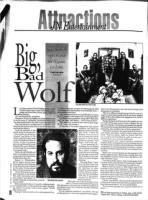
Los Lobos.
LYNNE I(ONSTANTIN
STAFF WRITER
Los Lobos: Berlin is on the far right.
os Lobos consists of David Hidalg ,
tually was part of a thriving band called
Conrad Lozano, bass, vocals; Ce
e played pretty much rockabilly, blues —
vocals; and Louis Perez, drums,
ts-band.
are Hispanic.
s opened up for us at the Whiskey [a-Go Go,
Oh, and Steve Berlin, saxophone.
enue for rock bands in the '70s and early '80s]."
d Berlin had co-produced, along with T-Bone Bur-
Formed in 1974 in Las Angeles, Los Lo iiibestrainval
for its hit cover of "La Bamba," the Ritchie Valens song nett, Los Lobos' 1983 album, ... And a Time to Dance.
"They asked if I wanted to learn some of their songs.
Los Lobos performed for the 1987 movie of the same title.
But ifyou look even a smidge beyond "La Barnba," you'll By '83, I was a full member."
hear that the hit that came to be an icon for the band does
At that time in Los Lobos' (Spanish for "the wolves")
anything but define it.
evolution, the band was
Look, for example, at the
playing much more folk-
band's choice for saxophonist.
? loric music. "I think the
"I had a profoundly Jewish up-
Fr9 Whiskey show was one of
bringing," says Berlin, 42. His
the first times they tried to
father, raised Orthodox, made
play rock 'n' roll as a group,
a point of instilling Judaism in
outside of a garage," says
his son. "In fact, my parents
2 Berlin. "And it was a hit.
gave me my first sax for my bar
"It was somewhat of a
mitzvah. We went to Manny's
challenge for me [fitting
in New York City and picked
into the band musically].
out a soprano sax."
But I wasn't a purist; I
Berlin, his wife Michelle and
could pick up on anything,
their two daughters belong to
and was open to new stuff.
a chavurah on the island near
We all made our own way
Seattle where they live.
with it; we were all exper-
imenting."
Raised in Philadelphia,
Berlin began playing saxo-
Plus, says Berlin, "I grew
(.1) phone when he was 9, learning
up on the East Coast, was
by ear from the music he heard
a second-generation Jew-
LIJ
on the radio. He also played
ish American (to their
= flute, and was a big jazz fan.
being first- and second-gen-
cn
— "All my friends growing up
eration Mexican Ameri-
cans). We were all children
Li, were musicians. It was the late
• '60s, and it was pretty cool to
of the '60s. It was surpris-
ing that we did have so
have a band," says Berlin. "It
much in common."
started innocently, and gradually, music be- Steve Berlin: Big, bad wolf.
Being that Los Lobos had begun as an
L.L, came a career."
ethnic, Chicano band experimenting with
Berlin attended Indiana University, studying music,
'-`1 but "realized early on that the kind of music I was play- folk instruments, the band was a natural contributor of
where I was going, I didn't need a degree." He left soundtrack music for La Bamba, the film of Ritchie
Valens' short life.
after his first year.
"It was a pleasant experience," says Berlin. "We had
Playing in various bands and in various genres of mu-
no idea going into it that what happened would happen.
T
o
=
-
78
And it was fascinating to see that kind of large-scale
thing going on firsthand.
"But it's a different thing having a hit of a cover of a
song for a movie than having a hit of one of your original
songs. If that, God willing, ever happens to us, it'd be a
different experience."
Though the band could have gone the straight and nar-
row route of '50s-style norteno music, riding on the suc-
cess of "La Bamba," its intuition was exactly the opposite.
The commercial success that lifted the band from its bar-
band status also instilled a fear of being categorized.
"We had to cauterize the experience from what we
were. On the next album, we felt we had to make a clean
break." That next album, 1988's La Pistola Y El Cora-
zon , as well as all that followed, right up to last year's
Colossal Head, was a musical melting pot.
Infusing punk rock, visceral grooves, traditional
rhythms, funk, searing guitars and everything else you
can think of, the members of Los Lobos have developed
a reputation as uncompromising innovators, a reputa-
tion that was further sealed with the rave-reviewed Colos-
sal Head.
Berlin's own musical interests are also apparent in the
band's conglomeration. With tastes ranging from Cap-
tain Beefheart and Tom Waits to Sun-Ra, Berlin is also
a fan of klezmer music.
"I've come to really enjoy it. Also, Jewish gypsy music;
it's about 40-50 years old, from Transylvania, Hungary
... Eastern Europe. I've always got my antenna up."
Made in only six weeks in 1996, Berlin says of the
in-studio Colossal Head experience: "We've been very
lucky, being able to show up at the studio without a lot
of pre-ideas. We let whatever happens happen. That's
not to say we have no idea what we're going to do, but we
happen to be good at creating on the spot. We tend to
keep a lot of first takes.
"I think," says Berlin, "that we are the sole purveyors
of what we do. I don't think that there is anyone else out
there who sounds like us. I'm very proud of that.
"It's an amazing group to be a part of. There are no
limits."
❑
Los Lobos appears 8 p.m. Friday, Aug. 1. $15. Clutch
Cargo's, 65 E. Huron, Pontiac. Call (248) 333-2362.