
This space contributed as a public service.
>-0
duties.
"We're trying to mobilize a con-
sensus that this is a good thing
for Jordan, but also for the peace
process," he said.
After the Israel-Jordan peace
treaty was signed in 1994, he
said, 'there was a lot of resistance
in Jordan. But people are com-
ing to realize that this is what
the peace process is all about.
The politicians allowed this to
happen, and we mobilized very
quickly. The private sector in Is-
rael has been very supportive, as
well as the Jordanian govern-
ment."
Much to the surprise of many,
"we've continued normalization
even during these negative
times, when many are very an-
gry at Israel," Mr. Salah said.
But normalization, he said,
still is inextricably tied to a
healthy peace process.
'There is the danger that this
could all unravel," he said. "If the
situation continues to deterio-
rate, relations between Israel
and Jordan could subside. If that
happens, we would be out on a
limb. How long can the econom-
ic work of one company prevail
over huge negative political
forces?"
But economic cooperation, he
said, can change the attitudes
that have made the Israeli-con-
flict so intractable.
"A lot of people I hire grew up
hating Israelis and Jews," he
said. "When they start going to
Israel and meeting Jews, in a
matter of days these people come
around and realize this whole
conflict is a travesty."
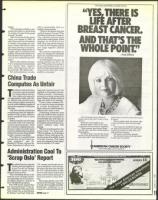
"YES,THERE IS
LIFE AFTER
BREAST CANCER.
AND THAT'S THE
WHOLE POINT:"
—Ann Jillian
China Trade
Computes As Unfair
T
he Clinton administration
continues to get pummeled
by conservatives and hu-
man-rights advocates for
its eagerness to trade with Chi-
na, despite that country's atro-
cious human rights record and
its role as the leading supplier of
advanced weaponry to countries
like Iran.
And some Jewish activists are
complaining that the adminis-
tration's China policy reflects a
double standard when it comes
to Israel.
, Beijing recently won the right
to buy one of the U.S.'s most ad-
vanced supercomputers, while
the Commerce Department con-
tinues to make it hard for Israel
to get less sophisticated machines
because of concerns about Israel's
nuclear weapons capability.
"The idea is to punish Israel
because they are involved in nu-
clear programs," said Dr.
Stephen D. Bryen, a former De-
fense Department official and
high-tech weapons expert who
testified on the subject recently.
"China is, as well — but our gov-
ernment is actively trying to sell
them billions of dollars worth of
high-tech stuff. So it's political."
There is clear evidence Chi-
na is using its supercomputers
in nuclear development, Dr.
Bryen said, but administration
officials don't seem to care.
Continuing American sales
will only reinforce that country's
activities as arms merchant to
countries like Iran and Libya, he
suggested. But Israel can hard-
ly complain because of its own lu-
crative military trade with
Beijing.
"They've put themselves into
a bad corner," Dr. Bryen said.
`They're selling a lot of sensitive
things to China, which gives Chi-
na even more of an ability to sell
to Israel's enemies. That takes
away any augment Israel might
have to restrain U.S. sales."
Administration Cool To
`Scrap Oslo' Report
T
he administration rejected
the key recommendation of
a new Council on Foreign
Relations report on the
Mideast peace process.
"The overriding theme is the
need for much stronger Ameri-
can leadership and involvement,"
said Henry Siegman, director of
the CFR Mideast program.
The CFR panel argued that
the "incrementalism" of the Is-
raeli- Palestinian talks since Oslo
"has turned into a prescription
for failure," and that "while the
U.S. cannot and should not im-
pose a settlement on the parties,
we believe the time has come for
the U.S. administration to offer
its own road map to Arab-Israeli
peace, and to use its influence to
move the parties in that direc-
tion."
The report calls for a new "De-
claration of Principles" based on
a "trade-off of tangible benefits:
Palestinian statehood in ex-
change for enhanced Israeli se-
REPORT page 127
A lot of women are so afraid of
breast cancer they don't want to hear
about it.
And that's what frightens me.
Because those women won't prac-
tice breast self-examination regularly.
Those women, particularly those
over 35, won't ask their doctor about a
mammogram.
Yet that's what's required for breast
cancer to be detected early. When the
cure rate is 90%. And when there's a
good chance it won't involve the loss of
a breast.
But no matter what it involves, take
it from someone who's been through
it all.
Life is just too wonderful to give up
on. And, as I found out, you don't have
to give up on any of it. Not work, not
play, not even romance.
Oh, there is one thing. though.
You do have to give up being afraid
to take care of yourself.
'AMERICAN
CANCER SOCIETY'
■
0
Get a checkup. Life is worth it.
•
1•1 ■ 1111 ■ 11P
4•11•M
■ ■
1111111
1116111,
Scanned image of the page. Keyboard directions: use + to zoom in, - to zoom out, arrow keys to pan inside the viewer.
June 27, 1997 - Image 119
- Resource type:
- Text
- Publication:
- The Detroit Jewish News, 1997-06-27
Disclaimer: Computer generated plain text may have errors. Read more about this.